
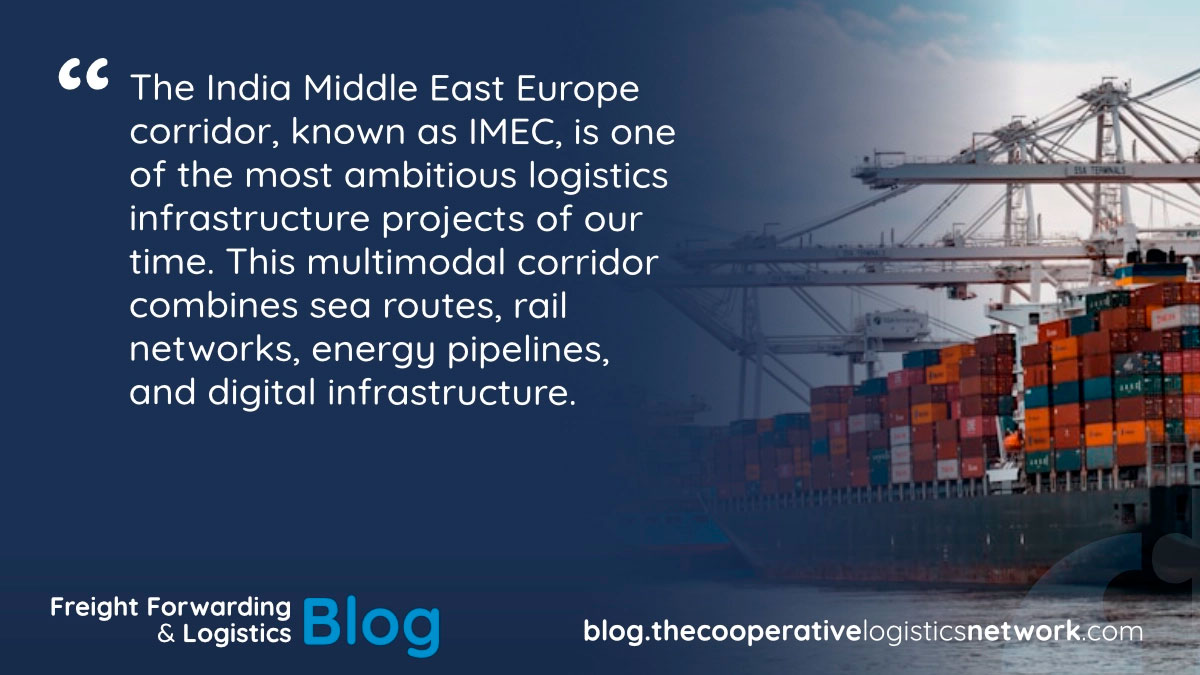
There’s a conversation happening in boardrooms, port authorities, and government ministries across three continents. It’s about a trade route that doesn’t fully exist yet but is already reshaping how freight forwarders think about the future. The India Middle East Europe corridor, known as IMEC, is one of the most ambitious logistics infrastructure projects of our time. Announced at the G20 Summit in New Delhi in September 2023, it was signed by India, Saudi Arabia, the UAE, the EU, France, Germany, Italy, and the United States. The vision: a multimodal corridor combining sea routes, rail networks, energy pipelines, and digital infrastructure stitching together three of the world’s most dynamic economic regions into a single, integrated trade artery. For freight forwarders paying attention, this isn’t just a geopolitical story. It’s a business opportunity in the making.
Why This Corridor, Why Now
To understand why IMEC is gaining momentum, you have to look at what’s been happening to the routes that global trade currently depends on. The Suez Canal for decades the default path between Asia and Europe has become a liability. The 2021 blockage was embarrassing. The Red Sea crisis that followed was something more serious: a structural reminder that concentrating global freight through a single chokepoint is a risk that compounds with every passing year. Rerouting via the Cape of Good Hope costs time and money that shippers simply don’t want to keep absorbing.
Meanwhile, China’s Belt and Road Initiative has spent a decade reshaping connectivity across Asia, Africa, and parts of Europe, on Beijing’s terms, with Beijing’s financing. IMEC is, among other things, a direct answer to thhttps://blog.thecooperativelogisticsnetwork.com/2025/07/31/belt-and-road-initiative-strategic-logistics-hubs/at reality. As the Atlantic Council noted in its detailed analysis of the corridor, IMEC “provides an alternative to existing corridors dominated by a single government.” (Atlantic Council, 2025) The timing isn’t coincidental. The appetite for supply chain diversification, accelerated by COVID, the Red Sea, and the general unpredictability of the last five years, has created political will that simply didn’t exist before.
What the Corridor Actually Looks Like
IMEC runs in two legs. The Eastern Corridor connects India’s western ports, Mundra and Nhava Sheva (JNPT) to the Arabian Gulf by sea. The Northern Corridor then picks up the cargo and moves it overland by rail through Saudi Arabia, into Jordan and Israel, out through Haifa Port, and across the Mediterranean to European entry points, including Piraeus in Greece and Trieste in Italy.
It’s a genuinely multimodal proposition, ocean freight to Gulf logistics hub, then rail across the Arabian Peninsula, then ocean again into Europe. The GCC Railway Project, a $250 billion initiative to connect all six Gulf Cooperation Council states, forms the backbone of the overland segment. Both Saudi Arabia and the UAE have made the most progress on their national rail systems, with the UAE’s Etihad Rail recently opening its first operational connection on the Saudi border.
Moreover, the projected efficiency gains are significant. According to CSEP’s analysis, IMEC is expected to reduce freight time and costs on India-Europe routes by up to 40% and 30%, respectively. (CSEP, 2026) That’s not a marginal improvement, that’s a fundamental shift in the economics of moving goods between Asia and Europe.
Honest About the Challenges
It would be dishonest to write about IMEC without acknowledging that it has faced serious headwinds. The conflict in Gaza dealt a significant early blow. The original IMEC routing through Israel became politically complicated almost immediately after the MOU was signed, and progress slowed. Financing gaps particularly for the Jordan-Israel segment, estimated at around $5 billion remain unresolved. The geopolitics of a corridor that requires stable relations between Saudi Arabia and Israel is, to put it mildly, complicated.
Additionally, there is renewed diplomatic engagement among India, Gulf nations, and Europe. Construction of key infrastructure components began in April 2025. India and the UAE signed an Intergovernmental Framework Agreement specifically focused on IMEC logistics operations. And as recently as April 2026, reporting indicated that India, the UAE, and the US are actively looking at ways to regain momentum. (The Print, April 2026) The corridor isn’t on hold. It’s being built, lane by lane, agreement by agreement with the understanding that in infrastructure of this scale, patience is part of the strategy.
What It Means for Freight Forwarders on the Ground Today
Here’s where the conversation shifts from geopolitics to business. You don’t need to wait for IMEC to be fully operational to position yourself in its path. The trade flows it is designed to formalise and accelerate are already moving, just less efficiently, across less integrated routes. Forwarders who are building relationships and capabilities in the key nodes now will be the ones holding the advantage when the infrastructure catches up.
India freight forwarding growth is already real and accelerating, independent of IMEC. India’s manufacturing base is expanding rapidly as companies diversify away from China. Its trade agreements with the UAE, the UK, and the EU are generating new freight flows. The question for forwarders isn’t whether India-Europe volumes will grow, it’s whether you have the network to capture them.
The UAE as a Gulf logistics hub is an ongoing development. Jebel Ali is already one of the world’s busiest ports, and the UAE’s investment in rail, free zones, and digital trade infrastructure is deliberate preparation for IMEC’s corridor role. Forwarders with established UAE partnerships are sitting at the centre of where this corridor converges.
Moreover, Saudi Arabia logistics is undergoing a transformation under Vision 2030 that goes beyond oil dependency. Freight rail, port development at Jeddah and Dammam, and the creation of logistics zones are all investments that serve IMEC’s corridor ambitions — and create immediate opportunities for forwarders active in the Gulf market.
Therefore, for independent freight forwarders, perhaps the most compelling opportunity is this: IMEC isn’t being built to benefit the asset-heavy megacarriers alone. The corridor’s multimodal, multi-country nature means local expertise matters enormously.
A forwarder in Mumbai who understands export documentation for Gulf-bound cargo. A partner in Dubai who knows the rail-to-port handoff at Jebel Ali. A counterpart in Piraeus who can clear Mediterranean arrivals efficiently. This is the kind of distributed, trusted network that the corridor demands and that a well-connected global freight network is uniquely positioned to deliver.
The Bigger Picture: Trade Lanes Are Shifting
IMEC is the headline, but the broader story is that new trade routes are emerging across the board. India-Middle East trade lanes are seeing investment and volume growth that would have seemed ambitious five years ago. Moreover, Southeast Asian ports are stepping up as manufacturing shifts. The old certainties about which lanes matter and which don’t are being renegotiated in real time. Emerging freight markets reward the forwarders who move early. Building a relationship in a market before it becomes obvious is almost always more valuable than arriving after everyone else has. The forwarders who were building India capabilities a decade ago are well-placed today. The ones building Gulf-Europe multimodal expertise now will be well-placed a decade from now.
Geopolitics got freight forwarders into trouble in the Red Sea. But geopolitics — in the form of IMEC and the new Silk Roads, it represents is also opening some of the most interesting lanes the industry has seen in a generation. The question isn’t whether these corridors matter. It’s whether you’re positioned when they open.