
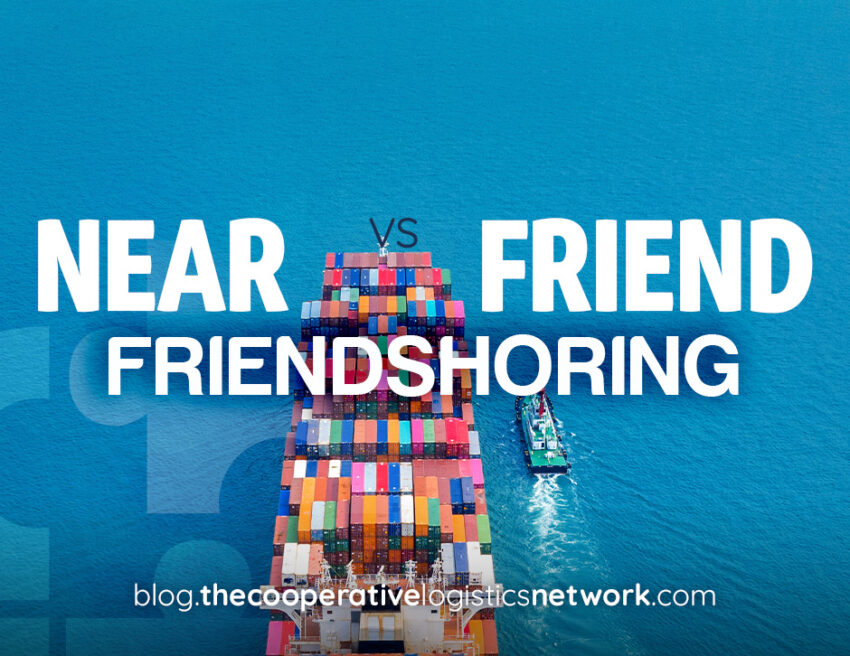
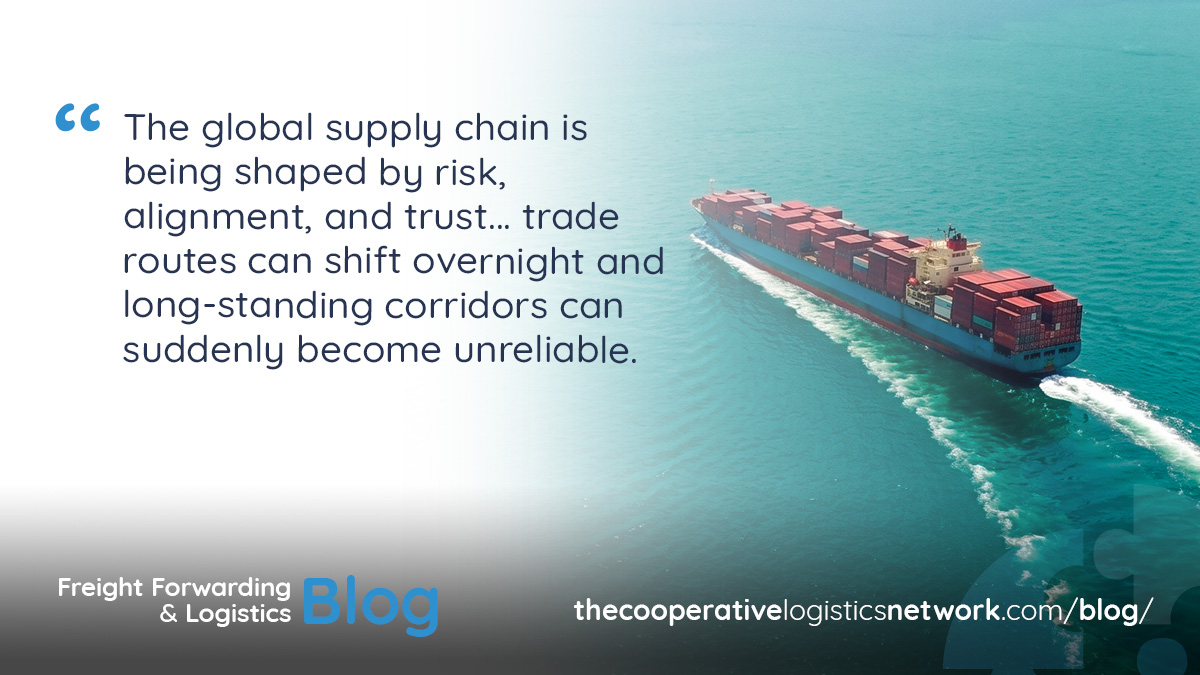
The global supply chain is no longer being shaped by cost alone. It’s being shaped by risk, alignment, and something less visible but far more decisive: trust. This is where nearshoring and friendshoring come in. They’re not just strategies. They’re responses to a world where trade routes can shift overnight, and long-standing corridors can suddenly become unreliable. And right now, that shift is happening in real time.
From Cost Efficiency to Risk Avoidance
For years, supply chains were built around optimization. The goal was to produce where it’s cheapest and move goods as efficiently as possible. That model is under pressure. Take the ongoing Red Sea crisis. Attacks on commercial vessels and rising geopolitical tensions have forced carriers to avoid one of the world’s most critical trade routes. The result? Ships rerouting around the Cape of Good Hope, adding up to 10–14 days to transit times and significantly increasing costs.
At the same time, instability in the Middle East is creating uncertainty across another critical chokepoint. The ongoing US–Israel–Iran conflict has disrupted shipping through the Strait of Hormuz, a route that handles a significant share of global energy flows. Rising tensions, vessel seizures, and restricted passage have already impacted shipping routes and fuel prices. What this means in practice is simple: routes that once felt predictable no longer are.
Nearshoring: Bringing Supply Chains Closer to Control
Nearshoring is the more visible response. Companies are moving production closer to end markets to reduce dependency on long, vulnerable routes. If a shipment doesn’t need to cross multiple high-risk regions, it becomes easier to control timelines and costs. For US-bound goods, that often means shifting production to Mexico or other parts of Latin America. For European markets, Eastern Europe becomes more attractive. This is not just about speed. It’s about control. If a crisis shuts down a major shipping lane, a shorter, regional supply chain is easier to adapt.
Friendshoring: Choosing Partners You Can Rely On
Friendshoring goes deeper. It’s not just about distance. It’s about alignment. Companies are prioritizing suppliers in countries with stable political relationships and predictable trade policies. The logic is to reduce exposure to sudden sanctions, policy shifts, or diplomatic breakdowns. Take the evolving relationship between the United States and Cuba. Trade and logistics flows between the two have long been shaped by political decisions rather than market logic. Restrictions, easing, and reversals have all directly impacted how goods move. For businesses, that unpredictability becomes a risk factor. Friendshoring is about avoiding that kind of volatility.
The Invisible Map of Trust
Supply chains are no longer mapped just by geography. They are mapped by trust.
- Which routes are safe?
- Which countries are stable?
- Which partners will still be viable a year from now?
The Red Sea disruptions didn’t just delay shipments. They forced companies to rethink entire routing strategies. The tensions in the Strait of Hormuz didn’t just affect oil. They exposed how quickly a single chokepoint can impact global trade. This creates an invisible map. One that is constantly changing.
Where Freight Forwarders Step In
This is where the role of freight forwarders starts to evolve. In the past, forwarders were expected to execute. Move cargo efficiently, manage documentation, and ensure delivery.
Now, clients are asking different questions.
- Should we avoid this route entirely?
- Is this country still a reliable sourcing option?
- What’s the risk of disruption over the next six months?
These are not operational questions. They are strategic ones. And increasingly, they are landing on the desk of logistics providers.
From Operators to Advisors
Freight forwarders sit at the center of global trade flows. They see disruptions as they happen. They understand how routes shift, how costs change, and how risks develop. That gives them a unique advantage. A forwarder who understands the impact of the Red Sea crisis can suggest alternative routing strategies before delays hit. Or a forwarder tracking Middle East tensions can anticipate cost increases tied to fuel and insurance.
In other words, a forwarder aware of political relationships can guide clients toward more stable sourcing regions. This is where the shift happens. From operator to advisor.
The New Complexity of Supply Chains
Nearshoring and friendshoring don’t simplify supply chains. They redistribute complexity. Instead of relying on one global hub, companies are building networks across multiple regions. That means more coordination, more partners, and more variables. Each region comes with its own:
- Regulatory environment
- Infrastructure limitations
- Political risks
Managing this requires more than execution. It requires insight.
Why Trust Becomes the Core Currency
In this kind of environment, trust stops being a soft idea and becomes something operational. It shows up in very practical decisions that determine whether cargo moves smoothly or gets stuck halfway through its journey. Trust in routes means knowing which corridors are still reliable, which ones are under pressure, and how quickly conditions can change. A route that worked last month may not carry the same level of certainty today, especially when geopolitical tensions or maritime disruptions come into play.
Trust in partners is just as critical. Freight forwarding today depends on a chain of people spread across countries and time zones. The difference between a smooth shipment and a delayed one often comes down to whether your local agent, carrier, or handler can respond quickly and consistently when things shift on the ground. Trust in systems ties everything together. Digital platforms, tracking tools, customs processes, and communication systems all need to work in sync. When they do, decisions become faster and more informed. When they don’t, even simple movements can become complicated.
Freight forwarders sit right at the center of all three layers. Their role goes beyond moving cargo from one point to another. They continuously interpret changing conditions, rely on established relationships across markets, and coordinate across multiple systems that don’t always speak to each other seamlessly.
Final Thoughts
Nearshoring and friendshoring are often framed as cost or efficiency strategies. But at their core, they are about something else. They are about reducing uncertainty in a world where uncertainty is increasing. The Red Sea crisis, the tensions in the Middle East, and shifting political relationships are not isolated events. They are signals of a broader change in how global trade operates. For freight forwarders, this is a turning point. Because when supply chains are built on trust, the people who understand that trust don’t just move cargo. They shape decisions.