


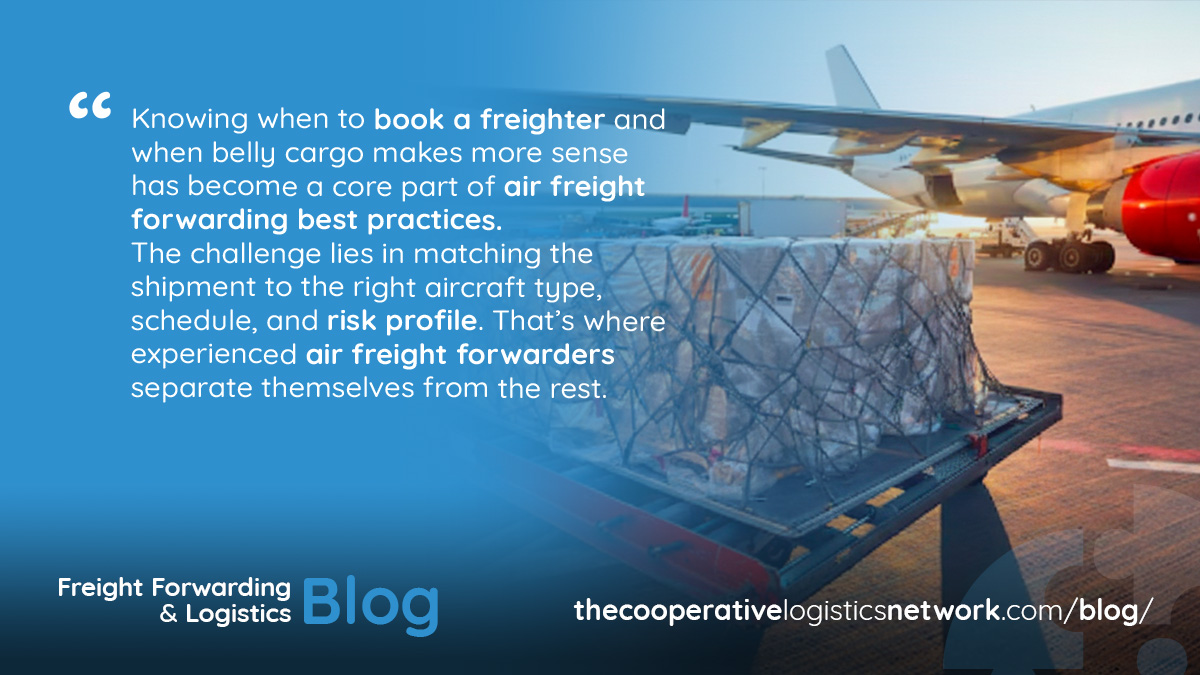
Air freight decisions in 2026 directly affect cost control, service reliability, and customer confidence. For forwarders, knowing when to book a freighter and when belly cargo makes more sense has become a core part of air freight forwarding best practices, not an afterthought. The challenge isn’t availability alone. It’s matching the shipment to the right aircraft type, schedule, and risk profile. That’s where experienced air freight forwarders separate themselves from the rest.
Air freight forwarding best practices start with cargo-driven decisions
The first rule of air freight forwarding best practices is simple: let the cargo decide. Too many problems in air freight come from forcing shipments into the wrong mode. Air cargo mode selection should begin with a clear assessment of four factors: size, weight, urgency, and sensitivity. Oversized machinery, temperature-controlled pharma, lithium batteries, and dangerous goods all behave differently in transit. So do e-commerce parcels and automotive spares. Freighter vs belly cargo is a suitability question. The best forwarders should ask which option actually fits the shipment.
Freighter vs belly cargo: understanding the core differences
To make smart decisions, forwarders need to understand the differences between freighter and passenger aircraft cargo beyond surface-level assumptions. Freighter aircraft are purpose-built. They offer higher payload limits, wider doors, and fewer restrictions on cargo type. This makes them ideal for heavy, oversized, or regulated shipments. Freighter aircraft utilization also tends to be more predictable because schedules are driven by cargo demand, not passenger flows. Belly cargo operations, on the other hand, depend on passenger aircraft schedules. Capacity fluctuates with travel demand, route profitability, and seasonality. While belly cargo can be cost-effective, it comes with tighter dimensional limits and a higher risk of offloading when passenger baggage takes priority. Understanding these structural differences is essential when planning air freight in 2026.
Air freight capacity 2026 and what it means for mode choice
Air freight capacity in 2026 remains uneven. While global capacity has improved compared to crisis years, it hasn’t returned to a fully balanced state. Passenger traffic is strong on some routes and weak on others, which directly impacts belly capacity availability. This is where cargo aircraft capacity planning becomes critical. Freighter fleets are expanding, but not always where demand spikes fastest. Some lanes are oversupplied, others are tight for weeks at a time. Forwarders who rely heavily on belly cargo must track airline schedules closely. A route that looks reliable today can lose capacity overnight due to aircraft swaps or frequency reductions. Freighter capacity, while often more expensive, offers stability when passenger networks shift.
Air freight forwarding best practices during peak season 2026
Peak season planning is where the difference between average and strong forwarders becomes obvious. Air freight planning during peak season 2026 requires early decisions, firm allocations, and realistic promises to customers. During peak periods, reliability differences between freighter and passenger flights widen. Passenger flights prioritize luggage and operational recovery. Cargo gets bumped first. Freighters, while not immune to disruption, are far less likely to offload confirmed cargo. This is why air freight forwarding best practices during peak season often favor freighters for time-critical shipments, even when belly rates look attractive on paper. Paying slightly more upfront can prevent missed delivery windows, penalties, and damaged customer trust.
Cost comparison freighter vs belly cargo 2026
Cost is still part of the equation, but it needs context. The cost comparison freighter vs belly cargo 2026 is no longer just about rate per kilo. Belly cargo often offers lower base rates, especially on high-frequency passenger routes. But hidden costs add up quickly: rollovers, storage charges, rebooking fees, and extended transit times. Freighters typically carry higher linehaul rates, but fewer surprises. When you factor in reliability, faster recovery from disruptions, and lower risk of delays, total landed cost often narrows more than shippers expect. The forwarder’s job is to explain this clearly, not just quote the cheapest option.
Best air freight mode for oversized or dangerous goods
Some shipments make the decision for you. The best air freight mode for oversized or dangerous goods is almost always a freighter. Large industrial equipment, oil and gas components, and construction cargo simply won’t fit in passenger aircraft holds. Dangerous goods, especially those with stricter handling requirements, face far fewer limitations on freighters. Trying to push these shipments into belly cargo channels wastes time and increases rejection risk. Experienced forwarders identify these cases early and build freighter solutions from day one.
How airline schedules affect cargo transit times
One overlooked factor in air cargo mode selection is how airline schedules affect cargo transit times. Passenger flights may operate daily, but cargo cut-off times, ground handling delays, and connection windows can stretch total transit. Freighters often fly at night and connect through dedicated cargo hubs designed for fast transfers. This can significantly reduce door-to-door transit, even if flight frequency is lower. Forwarders who map full transit timelines, not just flight durations, consistently make better mode choices.
Securing guaranteed capacity in a tight market
One of the biggest challenges in 2026 is how forwarders secure guaranteed air freight capacity. Spot bookings are risky when markets tighten. Strong forwarders combine multiple strategies: block space agreements on freighters, preferred carrier partnerships, and diversified routing options. They also avoid overcommitting to a single airline or mode. Freighter aircraft utilization agreements, in particular, give forwarders leverage during disruptions. When capacity is contractually secured, service levels hold even when markets turn volatile.
Reliability as a competitive advantage
In 2026, reliability sells. Shippers remember missed flights more than they remember small rate differences. Understanding reliability differences between freighter and passenger flights allows forwarders to guide customers toward smarter choices. Some clients will still choose belly cargo for cost reasons, and that’s fine, as long as the risks are clear. Others will gladly pay for freighter solutions when timelines matter. The forwarder who explains the trade-offs honestly earns long-term loyalty.
Final thoughts: matching mode to mission
There is no universal winner in the freighter vs belly cargo debate. The right answer depends on the shipment, the lane, and the customer’s priorities. Air freight forwarding best practices in 2026 are about flexibility, knowledge, and transparency. Forwarders who understand air cargo mode selection, capacity dynamics, and operational risk will consistently outperform those who rely on habit. Match the mode to the mission, and air freight becomes a tool for reliability, not a gamble.