
For most of the past decade, Syria sat at the edge of the shipping map. Sanctions, security risks and damaged infrastructure kept many carriers and forwarders away, and the cargo that did move often took indirect routes. That picture is now shifting. Vessel calls are climbing, global operators are investing in terminals, and sanctions are being eased step by step. For freight forwarders, the question is no longer whether Syrian cargo is back in play, but how to approach it with care.
Why Syria Ports Are Back on the Forwarder’s Radar
Syria has five main ports (Latakia, Tartus, Jableh, Banias and Arwad), overseen by the General Authority for Land and Maritime Ports. Together they offer Mediterranean access for Syria’s own trade and, increasingly, for cargo moving to and from neighbouring markets. This article looks at what the recovery looks like in the data, where the investment is going, what compliance demands, and how logistics companies in Syria can connect with partners abroad.
The numbers behind the recovery
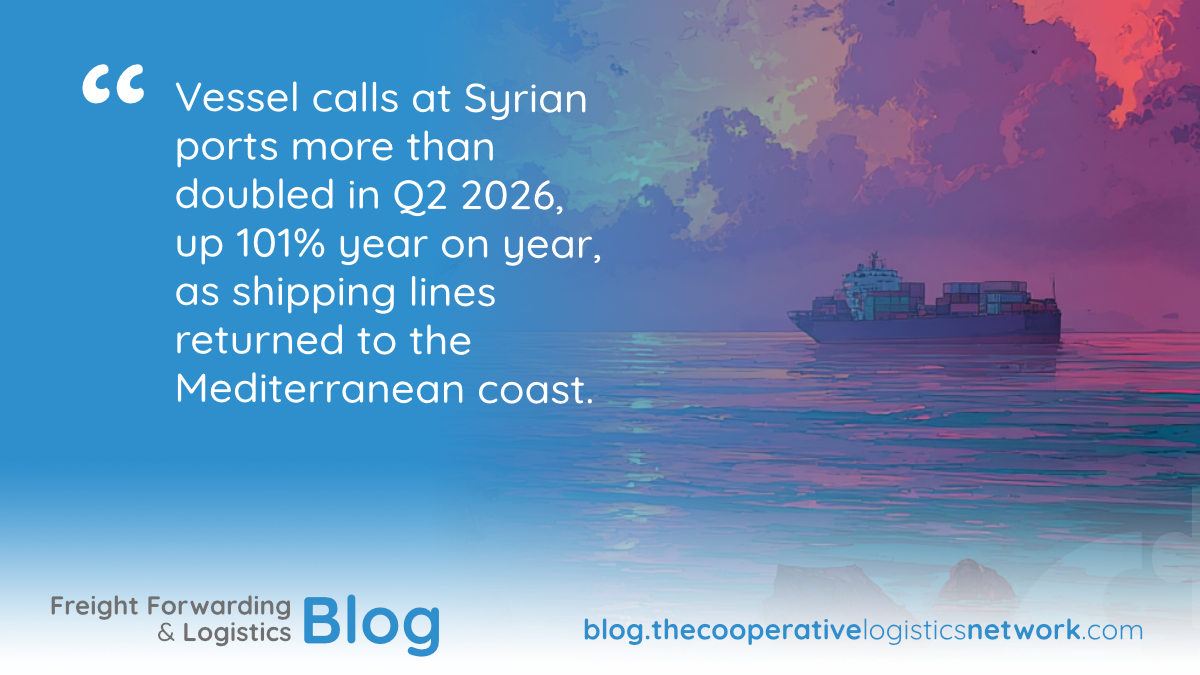
The recovery at Syria ports shows up clearly in vessel data. Lloyd’s List Intelligence figures reported by Crowell show 376 vessel calls in the second quarter of 2026, up 101% from a year earlier, with deadweight tonnage up 172%. First-quarter calls had risen 221% on the same quarter of 2025, and July 2026 saw 146 calls and more than 3.8 million dwt, the highest monthly figure since the fall of the Assad government in December 2024.
Containers are part of the story. Containership calls rose to 73 in the second quarter from 40 a year earlier, with CMA CGM accounting for 16 of them. Bulk cargo has grown even faster, with bulk carrier calls increasing from four in the first quarter of 2025 to 61 in the first quarter of 2026. Energy has moved too: Braemar data shows oil imports averaging 88,000 barrels per day in the second quarter, down 28% from the first quarter but well above 2025 levels, while crude tanker arrivals rose from one to 14 year on year. Growth from a low base looks dramatic in percentage terms, but the direction is unmistakable.
Where the investment is going
Global operators are putting money behind the trend. CMA CGM is working on a €200m modernisation of Latakia’s container terminal, while DP World has begun an $800m investment programme at Tartus under a 30-year concession. The Tartus arrangement followed Syria’s cancellation of a 2019 agreement with Russia’s Stroytransgaz, which Damascus said had failed to deliver the promised investment.
Energy and regional trade are shaping flows as well. After disruption in the Strait of Hormuz earlier in 2026, Iraq began trucking high-sulphur fuel oil across the reopened Syrian border for export through Banias, and fuel oil dominated Syrian oil exports in the second quarter, with cargoes re-exported from Banias and Tartus. Analysts quoted by Crowell describe the trucked-oil route as logistically challenging, a reminder that new corridors bring operational friction as well as opportunity. For forwarders, that friction, from border handling to trucking capacity and storage, is where specialist knowledge adds value.
| Port | Recent development |
|---|---|
| Latakia | CMA CGM €200m container terminal modernisation |
| Tartus | DP World $800m programme under a 30-year concession; fuel oil re-exports |
| Banias | Re-export point for fuel oil trucked from Iraq |
Taken together, these projects suggest that Syria ports are being repositioned for container and bulk trade, not simply restored to what they were.
Compliance: sanctions relief is not a green light
Easing does not mean an open door. Under current US export control guidance, most EAR99 items can be exported or re-exported to Syria under License Exception Syria Peace and Prosperity (SPP), but items on the Commerce Control List still need a licence unless another exception applies. OFAC Syria-related sanctions continue to apply to US persons, and end-use and end-user restrictions remain, including those on Specially Designated Nationals (SDNs). Other jurisdictions have their own rules, so forwarders should check every leg of a shipment.
A sensible approach before booking cargo through Syria ports includes:
- Screening shippers, consignees, banks and vessels against sanctions lists.
- Classifying the goods and checking whether a licence or exception applies.
- Confirming the end use and end user, and keeping records.
- Checking carrier, insurer and bank appetite before promising a booking.
- Agreeing documentation requirements with the destination agent in advance.
This article offers general information, not legal advice, so confirm current rules with your compliance team or counsel.
Why joining an international network matters for Syrian logistics companies
As volumes recover, logistics companies based in Syria face a practical challenge: international shippers and forwarders want a reliable, vetted partner on the ground, and building a worldwide presence alone is out of reach for most. Joining an international network such as The Cooperative Logistics Network offers a way forward. Membership can connect a Syrian company with over 365 independent partners in markets around the world, giving it a ready channel for inbound and outbound enquiries instead of relying on cold outreach.
It also places the company inside a community that shares practical know-how on documentation, compliance and customs, which matters while rules are still changing. A recognised network affiliation can help build trust with overseas counterparts who might otherwise hesitate, and regular contact with partners makes it easier to coordinate multimodal moves, from the Mediterranean ports onward by road. As cargo through Syria ports grows, being visible to the right partners at the right time can matter as much as terminal capacity.
What forwarders should do now
Syria is not yet an easy market, but it is no longer a closed one. Forwarders who want to be ready should track port and sanctions developments closely, build contacts with reliable local agents, and put screening and documentation processes in place before the first enquiry arrives. The routes are reopening, the terminals are being rebuilt and the volumes are rising. Those who prepare now, with sound compliance and the right partners on both ends of the shipment, will be best placed to benefit as the market matures.