


In air freight operations, a confirmed booking does not always guarantee that cargo will be accepted for carriage. Shipments can be rejected at the airport because of documentation discrepancies, inadequate packaging, incorrect measurements, security compliance issues, or failure to meet specific airline requirements. Understanding IATA cargo acceptance procedures helps freight forwarders identify these risks before cargo reaches the airline terminal, reducing avoidable delays, additional handling costs, and missed flight connections.
Cargo acceptance is a critical checkpoint in the air freight supply chain. Before a shipment is considered ready for carriage, airlines and their ground handling partners must verify that the cargo meets the applicable transport, safety, security, and operational requirements. For freight forwarders coordinating shipments across multiple countries and airline partners, preparing cargo correctly at origin is essential to maintaining reliable transit schedules.
What Are IATA Cargo Acceptance Procedures?
IATA cargo acceptance procedures refer to the operational checks and industry guidance used to assess whether a shipment is suitable for air transportation. The IATA Cargo Handling Manual (ICHM) provides guidance on processes across the cargo journey, including shipment preparation, carrier handover, acceptance as ready for carriage, and subsequent handling.
These checks help ensure that cargo is correctly documented, properly packed, accurately declared, and compliant with the requirements applicable to its contents and routing. However, acceptance is not governed by one universal checklist for every shipment. Requirements can vary depending on the cargo type, airline, origin and destination countries, security arrangements, and applicable regulations. For freight forwarders, the objective is to ensure that shipments are ready for acceptance before they arrive at the airport. A problem identified during pre-shipment checks is generally easier to resolve than one discovered at the cargo terminal shortly before the airline’s acceptance cut-off.
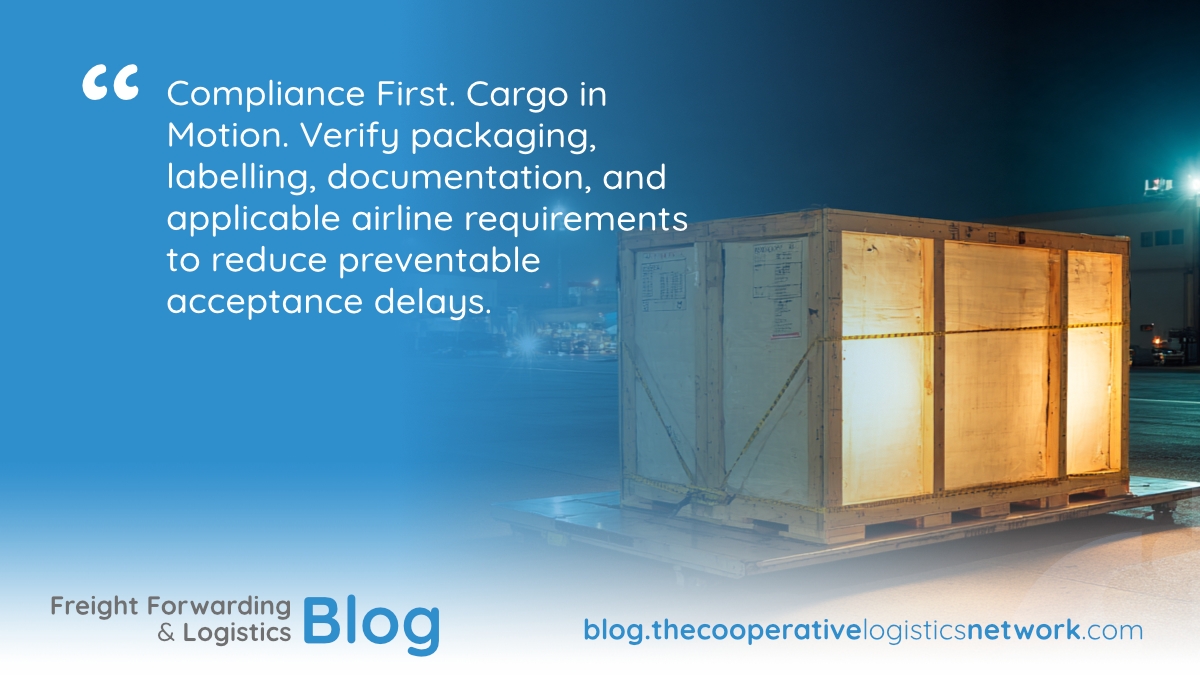
Common Reasons Shipments Are Rejected at the Airport
1. Incomplete or Incorrect Shipping Documentation
Documentation errors are among the most preventable causes of cargo acceptance problems. Incorrect shipper or consignee details, inconsistent cargo descriptions, mismatched package counts, and discrepancies in gross weight can trigger additional checks or require corrections before a shipment proceeds. For example, if the Air Waybill (AWB) lists 15 packages but the accompanying packing list or physical shipment indicates 16, the airline or handling agent may need clarification before accepting the cargo. Similar issues can arise when shipment details differ between the Master Air Waybill (MAWB), House Air Waybill (HAWB), commercial invoice, and applicable electronic declarations. Certain cargo types also require additional documentation, permits, certificates, or declarations.
How to prevent it: Freight forwarders should reconcile the AWB, commercial invoice, packing list, and relevant customs or regulatory documents before dispatching cargo to the airport. For specialised shipments, verify that all required supporting documents are available and that the information is consistent across the shipment records.
2. Improper Packaging, Marking, or Labelling
Cargo packaging must be suitable for the goods being transported and the handling conditions expected during air freight. Weak cartons, damaged outer packaging, leaking containers, insecure pallets, or unstable cargo can create safety and handling risks. Incorrect or missing labels can also lead to rejection, particularly for dangerous goods and shipments requiring special handling. Where applicable, packages must meet the relevant marking, labelling, and packaging requirements under the applicable regulations. For instance, a shipment containing regulated dangerous goods may be refused if its packaging, hazard labels, or documentation does not comply with the applicable provisions of the IATA Dangerous Goods Regulations (DGR).
How to prevent it: Inspect the cargo before dispatch and confirm that packaging can withstand normal handling and transport conditions. Check that required labels and markings are correct, visible, and consistent with the shipment documents. Dangerous goods must be prepared according to the applicable classification, packing, marking, labelling, and documentation requirements.
3. Incorrect Weight, Dimensions, or Package Count
Airlines need accurate shipment measurements to assess capacity, calculate applicable charges, and plan cargo loading. If the actual weight or dimensions differ from the details declared during booking, the shipment may require reweighing, remeasurement, revised charges, or additional handling. Oversized cargo can also present loading difficulties if its dimensions exceed the capabilities of the aircraft, cargo door, handling equipment, or planned unit load device (ULD). Similarly, cargo that has been palletised differently from the original booking may no longer match the declared measurements.
How to prevent it: Obtain final packed dimensions and gross weight wherever possible. Confirm the number of packages and identify any unusual dimensions or handling requirements before booking. If the shipment changes after the initial booking, notify the airline and update the relevant records before cargo handover.
4. Dangerous Goods Non-Compliance
Dangerous goods require particular attention because incorrect preparation can create serious safety risks. Batteries, chemicals, aerosols, flammable materials, and other regulated articles may be subject to specific classification, packaging, quantity limits, marking, labelling, and documentation requirements. Shipments may be rejected when a dangerous goods declaration is incomplete, packaging does not meet the applicable specifications, hazard labels are missing, or the cargo has been incorrectly classified. Undeclared dangerous goods can also be a concern when apparently ordinary products contain regulated substances or batteries. The IATA DGR provides detailed guidance for preparing and transporting dangerous goods by air. Airlines may also apply additional operator-specific restrictions or requirements.
How to prevent it: Establish the nature of the goods early in the booking process and obtain accurate product information from the shipper. Verify the applicable DGR requirements, including relevant state and operator variations, and ensure that trained personnel complete the necessary checks. Where required, use the appropriate dangerous goods acceptance checklist before offering the shipment for carriage.
5. Security Screening and Cargo Status Issues
Cargo must meet the applicable aviation security requirements before it can be transported. A shipment may be delayed or refused for the planned flight if its security status cannot be verified, required screening has not been completed, or the necessary security information is missing. Consolidated shipments require particular care because the security status and documentation of individual house shipments may need to be checked. A discrepancy affecting one consignment can complicate the handling of the consolidation. Security requirements differ across jurisdictions, so freight forwarders must follow the applicable local rules and the airline’s procedures.
How to prevent it: Confirm screening arrangements and security documentation before cargo reaches the terminal. Ensure that the shipment’s security status is accurately recorded and communicated to the airline or handling agent. For consolidated cargo, verify the relevant information for each individual shipment rather than relying solely on the master-level record.
6. Failure to Meet Airline Cut-Off Times or Special Handling Requirements
Even correctly prepared cargo can miss its planned flight if it arrives after the airline’s cargo acceptance cut-off. Acceptance involves more than physical delivery: documentation, security checks, and any required special cargo procedures must also be completed within the operational timeline. Shipments requiring temperature control, live animal handling, oversized cargo arrangements, or other specialised services may need advance coordination. A booking may need to be revised if the necessary equipment, capacity, approvals, or handling arrangements are unavailable.
How to prevent it: Work backwards from the airline’s latest acceptance time and allow sufficient time for cargo delivery, document verification, security screening, and corrective action if needed. Confirm special handling requirements and operational arrangements well before dispatch.
How Freight Forwarders Can Improve Cargo Acceptance Rates
Preventing IATA cargo acceptance procedures issues begins with a consistent pre-shipment process. Freight forwarders should not wait until cargo reaches the airport to discover that essential information is missing or that the shipment does not meet the carrier’s requirements. The following practices can help reduce rejection risks:
- Introduce a pre-acceptance checklist: Verify documentation, cargo description, package count, weight, dimensions, packaging, labels, and applicable regulatory requirements.
- Identify special cargo early: Flag dangerous goods, lithium batteries, temperature-sensitive products, oversized shipments, and other cargo requiring additional checks during the quotation and booking stages.
- Confirm airline-specific requirements: Check carrier restrictions, aircraft compatibility, handling capabilities, and applicable state or operator variations before confirming the shipment.
- Coordinate with shippers: Provide clear instructions on packaging, labelling, documentation, and cargo readiness so that requirements are understood before collection.
- Allow sufficient operational time: Plan for screening, warehouse acceptance, and possible corrections rather than relying on the final hours before departure.
- Maintain communication with destination agents: Share accurate shipment details and any special handling instructions to support transit planning and destination preparation.
These steps can help freight forwarders reduce avoidable rejection, protect customer relationships, and improve the predictability of air freight operations.
What Should Freight Forwarders Do When Cargo Is Rejected?
When a shipment fails an acceptance check, the first step is to establish the exact reason for rejection. Ask the airline or handling agent to identify the discrepancy and determine whether it concerns documentation, packaging, measurements, security, regulatory compliance, or operational restrictions.
Next, assess whether the problem can be corrected before the planned flight. Documentation errors may require amended records, while packaging or labelling issues may require physical intervention by appropriately qualified personnel. Dangerous goods discrepancies must be addressed in accordance with the applicable regulations and acceptance requirements.
Freight forwarders should also notify the shipper and relevant overseas partners if the rejection could affect the transit schedule. If the cargo cannot be accepted within the required timeframe, coordinate with the airline to explore rebooking or other permissible arrangements.
Finally, record the incident and review the process that led to it. Repeated rejection due to the same documentation error or packaging issue indicates that the pre-shipment workflow needs improvement.
Conclusion
Cargo rejection at the airport can disrupt schedules, increase operating costs, and create complications for freight forwarders and their customers. In many cases, the underlying issue can be prevented through accurate documentation, suitable packaging, verified measurements, appropriate security arrangements, and early coordination with the airline. By incorporating IATA cargo acceptance procedures into their standard operating practices, freight forwarders can identify compliance gaps before cargo reaches the terminal and resolve potential problems before they affect the shipment. The key is to treat cargo acceptance as a process that begins at the booking stage, not simply as a final check at the airport. In air freight, a shipment is more likely to move on schedule when its documentation, physical preparation, and operational requirements are addressed well before departure.