

Brazil is one of the world’s leading agricultural exporters, shipping enormous volumes of soybeans, sugar, coffee, meat, corn and other commodities to markets across Asia, Europe, the Middle East and beyond. At the centre of this export network is the Port of Santos, located on Brazil’s southeast coast in São Paulo state. In 2025, Santos handled a record 186.4 million tonnes of cargo, including 137.4 million tonnes of exports. The port also handled 5.9 million TEU and accounted for 29.6% of Brazil’s foreign trade by value. Agricultural cargo is a particularly important part of this activity. The port connects Brazil’s major producing regions with international markets, making Santos port agricultural exports an important part of the country’s wider logistics and supply chain network.
Why Santos matters to Brazil’s agricultural trade
Brazil’s agricultural export industry is enormous and highly diversified. In 2025, the country’s agribusiness exports included approximately US$52.9 billion in soybean products, US$31.8 billion in meat, US$16.5 billion in forestry products, US$16.1 billion in coffee and US$15.1 billion in sugar and ethanol products. Together, these five groups represented 78.3% of Brazil’s agribusiness export sales. Santos is one of the principal gateways connecting these commodities to overseas buyers.
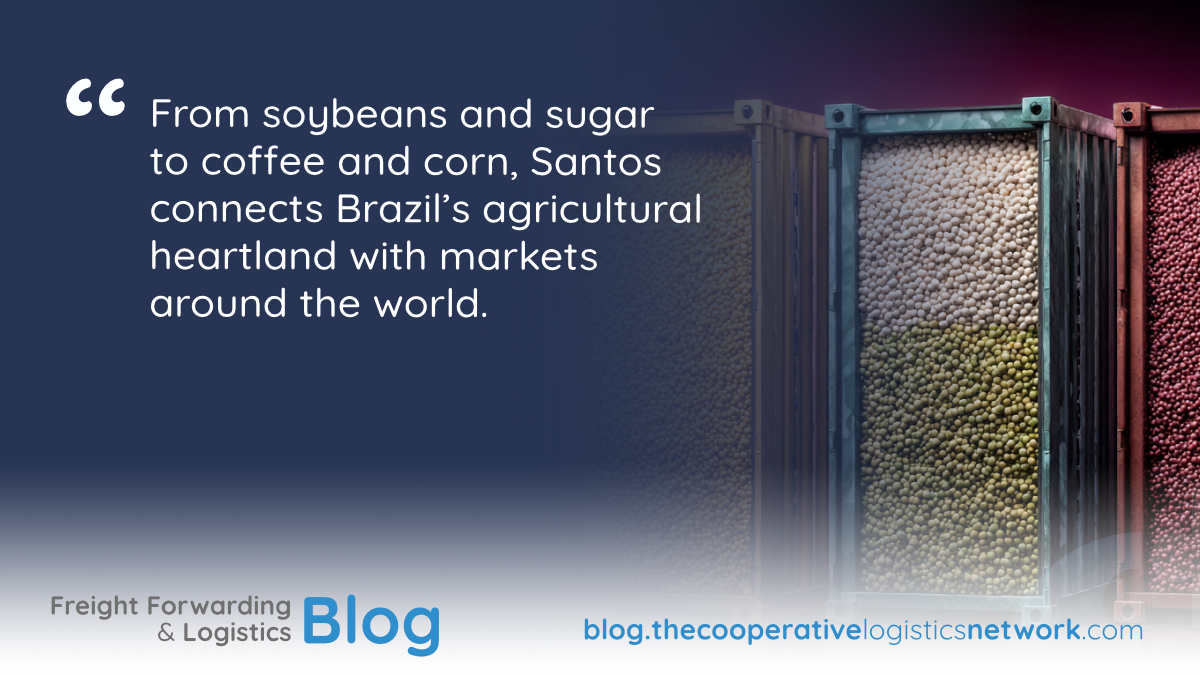
The port has an extensive network of terminals capable of handling bulk, liquid and containerised cargo. Its connections to Brazil’s industrial and agricultural hinterland also allow exporters from areas far from the coast to move production towards an international shipping gateway. This is particularly important for agricultural commodities because Brazil’s major producing regions are spread across a vast territory. Soybeans, for example, are heavily produced in the Centre-West, while sugar and coffee production is concentrated in southeastern states including São Paulo and Minas Gerais.
The logistics challenge is therefore not simply getting cargo onto a vessel. It is moving enormous volumes from farms, processing facilities and inland storage locations to the coast efficiently and reliably.
The commodities moving through Santos
Soybeans
Soybeans are one of the most important agricultural commodities handled through Santos. Brazil exported 108.2 million tonnes of soybeans in 2025, worth US$43.5 billion. China is the dominant international market for Brazilian soybeans, and Santos plays a major role in this trade. According to the USDA, Santos was Brazil’s largest soybean export gateway to China in 2025. Together with five other major ports, it accounted for 88% of Brazilian soybean export volumes to China. This creates a major Brazil–China trade lane in which inland transport, port handling and ocean freight need to work together. During the first half of 2025, the southern ports of Santos, Paranaguá, Rio Grande and São Francisco do Sul accounted for nearly 66% of Brazil’s soybean exports to China, with Santos handling 41% of that southern-port volume.
Sugar
Sugar is another major component of Santos’ agricultural cargo. Brazil is the world’s leading sugar exporter, and the Port of Santos is a major departure point for Brazilian sugar shipments. The port’s bulk terminals allow large quantities of sugar to be consolidated and loaded onto ocean-going vessels. This is particularly important for long-distance routes to Asia, the Middle East and other major consuming markets. Because sugar is transported in very large volumes, terminal capacity, storage availability and vessel scheduling are critical considerations for exporters and logistics providers.
Coffee
Santos has a long association with Brazil’s coffee trade. Historically, the port became closely linked with the country’s coffee exports, and coffee remains an important commodity moving through the complex. Unlike bulk grains and sugar, coffee can move through containerised logistics networks, requiring different handling and storage arrangements. The cargo may travel from producing regions to warehouses and consolidation facilities before being loaded into containers for international shipment. Brazil exported US$16.08 billion of coffee in 2025, with green coffee accounting for the overwhelming majority of that value.
Corn and other agricultural products
Corn is also an important export commodity through Santos, alongside soybean meal, meat, cellulose, orange juice and other products connected to Brazil’s agricultural economy. The diversity of cargo means the port is not dependent on one single agricultural supply chain. Instead, Santos functions as a multi-commodity gateway, serving different producers, exporters, shipping lines and international markets.
From Brazil’s interior to Santos
One of the defining features of Santos is the size of its hinterland. Agricultural production often begins hundreds or even thousands of kilometres from the port. Cargo must therefore travel through Brazil’s inland transport network before reaching the coast. Road transport remains important, particularly for connecting farms and processing facilities with rail terminals, warehouses and ports. Rail has become increasingly important for high-volume commodities because it can move large quantities over long distances.
Recent investment in the railway approaches to Santos is designed to increase capacity and improve the integration between rail and port operations. Infrastructure upgrades include additional railway yards, new track and signalling improvements, with the network being prepared to accommodate longer and heavier trains. For agricultural exporters, this multimodal connection is crucial. A shipment may follow a journey such as:
Farm → local road network → rail terminal → Santos → ocean vessel → overseas market. The efficiency of each stage affects the overall competitiveness of Brazilian agricultural exports.
Key international trade routes
The most important international routes from Santos reflect the destinations of Brazil’s agricultural products.
Santos–China
China is the port’s largest trading partner. In 2025, China accounted for 29.6% of the commercial transactions involving the Port of Santos. Soybeans are particularly important on this route, making the Santos–China trade lane one of the most significant agricultural shipping corridors connecting Brazil with Asia.
Santos–Europe
European markets receive Brazilian coffee, sugar, meat, soy products, orange juice and other agricultural commodities. The Europe-bound network can involve direct services as well as transshipment through major European container and logistics hubs. For freight forwarders, the route requires careful coordination between Brazilian inland transport, port operations and European distribution.
Santos–Middle East and other markets
Brazilian agricultural products also reach markets across the Middle East, Africa and other parts of Asia. The variety of destinations reinforces the importance of Santos as a flexible international gateway rather than a port serving only one major trade lane.
The logistics challenges behind Santos’ agricultural exports
The scale of Santos port agricultural exports also creates several logistical challenges.
Seasonal cargo peaks
Agricultural production is seasonal, which can create periods of particularly high export demand. When large volumes reach the logistics network simultaneously, exporters may face pressure on trucks, rail capacity, storage facilities, terminals and vessel space. Planning cargo movements well ahead of harvest and export periods can therefore be essential.
Inland congestion
The distance between producing regions and Santos makes inland transportation a major consideration. Road congestion, rail capacity, weather disruptions and equipment availability can all affect the time required to move agricultural cargo to the port. A delay inland can ultimately become a missed vessel, additional storage costs or a disruption to the export schedule.
Port capacity and terminal coordination
Santos handled more than 186 million tonnes in 2025, demonstrating both the scale of its operations and the demand placed on the infrastructure. The port is continuing to invest in capacity. New agricultural terminal infrastructure is also being developed, including COFCO International’s STS11 facility, which is designed to handle grains, sugar and soybean meal and is expected to reach an annual capacity of around 14–14.5 million tonnes when fully operational. For exporters, additional capacity can help accommodate growing volumes, but efficient coordination between terminals, inland carriers, warehouses and shipping lines remains essential.
Weather and cargo conditions
Agricultural commodities are naturally affected by weather. Heavy rainfall can affect harvests, roads and railways, while drought can influence production volumes and river-based alternatives elsewhere in Brazil. Cargo itself also needs appropriate handling and storage. Moisture, contamination and unsuitable storage conditions can affect the quality of agricultural products.
What Santos means for freight forwarders
For freight forwarders, Santos represents much more than a port of loading. It is a logistics ecosystem connecting agricultural producers, processors, exporters, inland carriers, terminals, shipping lines and overseas buyers.
Understanding this ecosystem can help forwarders manage the entire movement rather than focusing only on the ocean leg.
Key considerations include:
- Inland transportation from producing regions
- Road and rail availability
- Agricultural harvest cycles
- Bulk versus containerised cargo
- Terminal and storage capacity
- Vessel schedules and cut-off times
- Export documentation and customs procedures
- Cargo quality and storage requirements
- International destination requirements
- Contingency planning during periods of congestion or disruption
This is particularly relevant as Brazil continues to diversify its export markets. Greater agricultural production does not automatically translate into smoother logistics. The ability to connect inland production with efficient port and ocean networks remains fundamental.
Santos and the future of Brazilian agricultural exports
Brazil’s agricultural export sector is expected to remain an important part of global food and commodity supply chains. As international demand evolves, Santos will continue to compete and cooperate with other Brazilian gateways, including Paranaguá and the growing ports of the Arco Norte.
The country’s logistics network is therefore becoming more diversified. Northern ports are increasingly important for connecting Centre-West production to overseas markets through river and road networks, while southern and southeastern gateways such as Santos remain critical for major agricultural flows. In 2025, the Arco Norte ports handled 58 million tonnes of grains, illustrating the growing role of alternative export corridors.
Santos remains a crucial link between Brazil’s farms and the global marketplace. Its combination of large-scale terminals, inland connections, multimodal infrastructure and extensive international services makes it one of the country’s most important agricultural gateways. As Brazilian exports continue to reach consumers across Asia, Europe, the Middle East and other regions, the efficiency of the logistics network connecting production to Santos will remain central to the country’s position in global agricultural trade.