

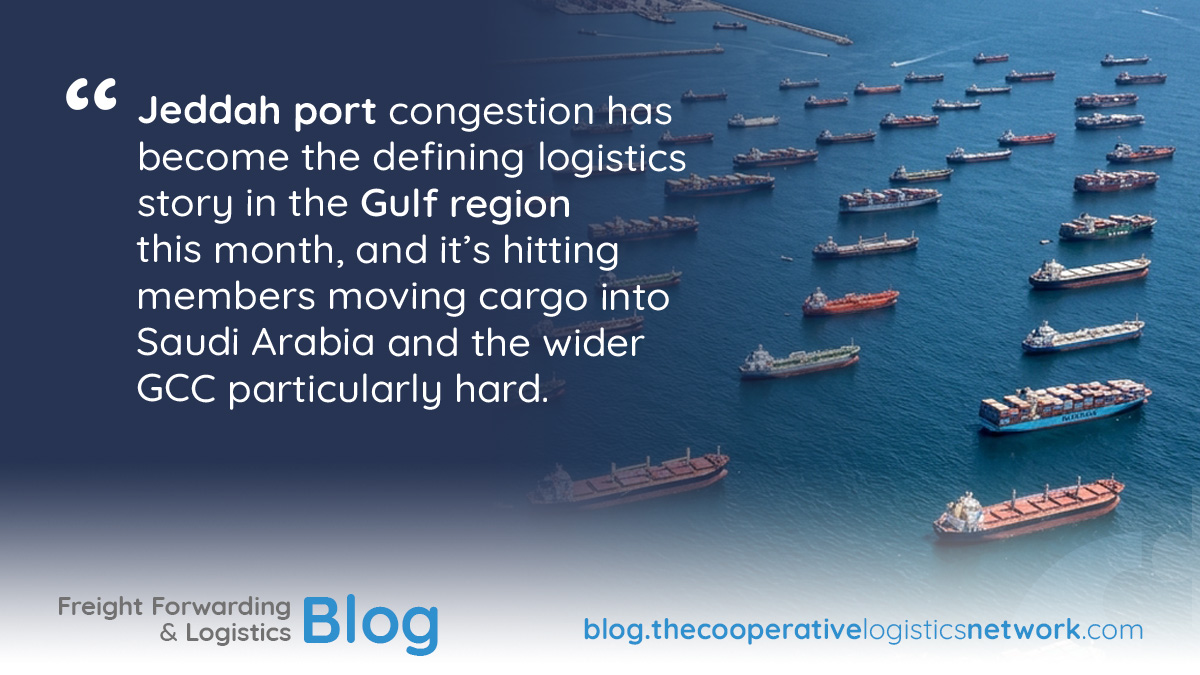
Jeddah port congestion has become the defining logistics story in the Gulf region this month, and it’s hitting members moving cargo into Saudi Arabia and the wider GCC particularly hard. What started as a workaround for Strait of Hormuz disruption has turned into a bottleneck of its own, and forwarders need a clear picture of what’s happening before they book their next shipment through the region.
How Jeddah Became the Region’s Pressure Valve
When transits through the Strait of Hormuz grew uncertain earlier this year, shippers and carriers leaned hard on the Gulf land bridge as an alternative, routing cargo through Jeddah on the Red Sea and trucking it onward across Saudi Arabia to reach UAE, Oman, Qatar, Kuwait, and Bahrain. It worked, for a while. But land bridge volume kept climbing even after a ceasefire agreement between Iran, the US, and Israel eased some of the original pressure, and Jeddah simply wasn’t built to absorb that much redirected traffic on top of its own regional trade.
The Numbers Behind the Bottleneck
The scale of the congestion is significant. Yard utilisation at Jeddah has reached 90% density, cutting terminal productivity by 20% to 25%. Truck queues outside the port have stretched to 5 to 6 kilometres, with some vehicles waiting up to three days just to enter the facility. Brokers report container release waits of six to eight weeks in the worst cases. The Fasah gate-pass system, which manages transit clearance, is also feeling the strain, and port operations are offering no concessions for missed slots caused by the congestion itself.
Saudi authorities have responded with a new rule requiring in-transit cargo to leave Saudi ports within 15 days of arrival or face penalties, with carriers responsible for monitoring compliance. That single change has led most major carriers to stop accepting bookings for in-transit cargo through Jeddah altogether, and several have started omitting Jeddah from their schedules entirely, redirecting shipments to alternative ports like King Abdullah Port, Djibouti, and Mundra instead.
There’s a genuine bright spot in the wider picture. Maersk has resumed trans-Suez sailings on its AE15 service, a joint decision with Hapag-Lloyd following what both carriers describe as a reassessment of Red Sea security conditions. It’s described as a gradual return rather than a full commitment, with contingency plans still in place to revert to Cape of Good Hope routing if conditions change. For members watching Red Sea security developments closely, this is a signal worth tracking, though not yet one to plan around with full confidence.
Two Shipments Caught in the Middle
Consider a member moving a container of industrial equipment from Ningbo, with a final destination in Riyadh. Because the bill of lading names a Saudi destination, the cargo can still discharge at Jeddah and move via the established land bridge, but the forwarder handling it needs to budget for six to eight week release delays and build that into the client’s delivery timeline from the outset. A forwarder who quoted this lane based on pre-congestion transit times risks a client relationship strained by expectations that no longer match reality on the ground.
Now consider a shipment bound for Dubai, discharged at Jeddah under the assumption that land bridge trucking would carry it the rest of the way. Because the final destination isn’t Jeddah itself, port authorities are increasingly discharging this kind of cargo at alternative ports instead, as they work to reduce pressure on the terminal. A forwarder who anticipated this shift and pre-booked routing through Khor Fakkan or Sharjah as an Arabian Sea alternative kept the shipment moving on schedule. One who didn’t is now scrambling to re-route mid-transit, absorbing costs that were entirely avoidable with earlier planning.
What Members Can Do Right Now
Several forwarders active in the region have been advising clients for weeks to avoid Red Sea routing into Jeddah altogether and shift to Arabian Sea services through Salalah, Khor Fakkan, or Sharjah instead. That advice is worth taking seriously for any GCC-bound cargo that doesn’t specifically require Saudi discharge. For shipments that do need to move through Jeddah, building the current six-to-eight week release window into client communications from the start protects the relationship far better than managing expectations after the fact.
How Cooperative Membership Helps Members Navigate This
This is exactly the kind of fast-moving regional disruption where being part of a connected network matters most. Cooperative members with an active presence in the Gulf are already adjusting routing strategies in real time, and that ground-level knowledge- which port is discharging what, which alternative routes are holding up, which carriers still have capacity, is far more valuable shared across the network than held by any single member alone.
If your desk is handling GCC-bound freight right now, reach out to fellow Cooperative members active in the region before you book. The congestion at Jeddah isn’t resolving quickly, and the forwarders navigating it best are the ones leaning on each other’s current, on-the-ground intelligence rather than working from outdated assumptions.