

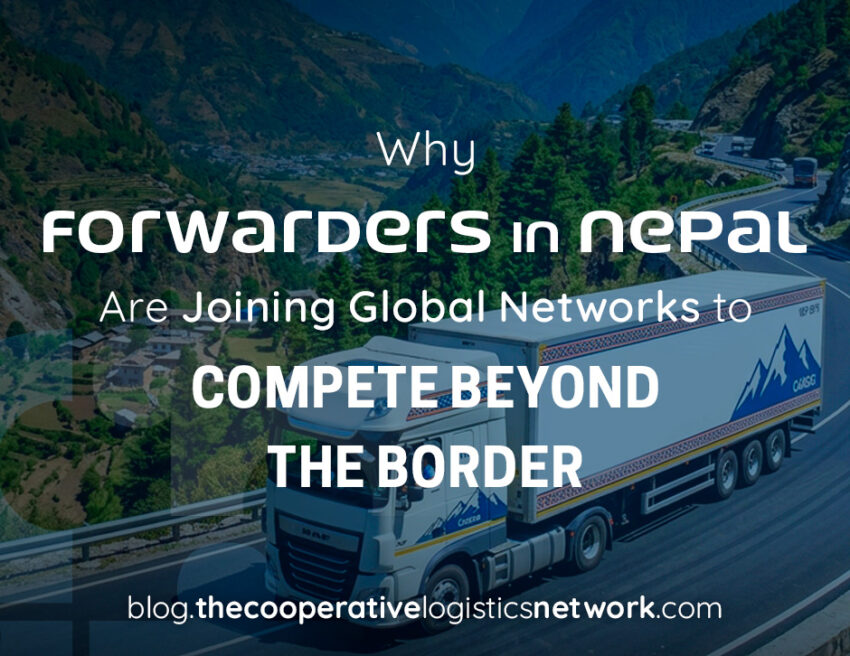
Nepal sits at a unique crossroads in global trade. Landlocked between two of the world’s largest economies, the country depends entirely on its neighbors for sea access, and every shipment that leaves or enters Nepal must first cross a border, a port, or both. For freight forwarders working out of Kathmandu, this geography shapes everything from pricing to scheduling to risk. Independence has traditionally been seen as a mark of strength in this industry, but for forwarders operating in a landlocked market, going it alone increasingly means going it without support. This is exactly why so many Nepali forwarders are now turning to a global logistics network to compete on equal footing with rivals who have ports, partners, and options that they do not.
The Landlocked Reality Nepali Forwarders Operate In
Nepal’s logistics sector faces a set of conditions that few other markets share. With no direct sea access, nearly all international cargo moves through Kolkata Port in India or Chittagong Port in Bangladesh before it ever reaches Nepali soil. From there, goods travel inland to dry ports such as Birgunj, which handles the bulk of cargo bound for the Kathmandu Valley, while air freight routes through Tribhuvan International Airport, the country’s only international gateway.
This dependency creates a layered set of risks that forwarders elsewhere rarely have to manage at the same scale. Monsoon rains and landslides regularly disrupt highway corridors. Congestion at Kolkata or Chittagong can hold shipments for days with no alternate routing available. Consider a Kathmandu garment exporter who had a full container sitting at Kolkata port during a congestion spike, with no local partner to expedite clearance or arrange a workaround. The shipment missed its delivery window, and the relationship with that overseas buyer never fully recovered. This is the kind of outcome that a stronger network connection can often prevent.
What Going It Alone Actually Costs You
Operating independently in a market this exposed carries a real cost, and it shows up in ways that are easy to underestimate. Smaller forwarders working without partners abroad often pay higher rates because they lack the volume to negotiate favorable terms with carriers. When a shipment runs into trouble at a foreign port, a forwarder with no presence there has limited options beyond waiting and hoping the issue resolves itself.
Clients notice this. A Nepali importer who experiences repeated delays because their forwarder has no one to call in Kolkata or Chittagong will eventually look elsewhere. Trust in this industry is built on responsiveness, and responsiveness depends on having someone on the ground when something goes wrong. Forwarders who recognize this are increasingly looking past their own borders for the support that local resources cannot provide.
Why a Global Logistics Network Changes the Equation
A global logistics network gives Nepali forwarders something that geography alone cannot. Membership connects forwarders with vetted partners across dozens of countries, which means access to local expertise at both ends of a shipment rather than just one. A Kathmandu-based exporter of handicrafts who needed a customs hold resolved in Hamburg was able to get same-week movement through a network partner there, a result that would have taken weeks to sort out through an unfamiliar agent found independently.
This kind of access also strengthens a forwarder’s negotiating position. Collective volume across a global logistics network gives members leverage on freight rates that a single small operator could never secure alone. Just as importantly, it gives forwarders a second opinion when a primary route fails, whether that means rerouting through a different port or finding alternate transport when a highway closes.
What Membership Actually Looks Like Day to Day
Joining an international freight network is not simply a matter of adding a logo to a website. In practice, it changes how a forwarder operates. Shared documentation standards across member companies reduce the back-and-forth that often slows down cross-border shipments. Partner-to-partner communication channels mean a problem at a foreign port gets flagged and addressed in hours rather than days. Referral business also flows in both directions, with overseas partners sending cargo bound for Nepal to a trusted local member, and Nepali forwarders sending outbound shipments to partners who already understand the destination market.
This kind of coordination matters most when supply chains involve multiple stages. A shipment originating in Kathmandu might require inland trucking to Birgunj, customs clearance at the border, onward transport to Kolkata, and ocean freight to a final destination overseas. Effective communication between every partner involved in that chain is what keeps the cargo moving without unnecessary delays, and that level of coordination is difficult to achieve without an established network behind it.
Why Global Partnerships Matter for Inland Logistics
Nepal’s position as a landlocked nation makes the case for global partnerships even stronger than in most markets. Freight forwarders operating out of Kathmandu are uniquely positioned to connect Nepali exporters, from handicraft and garment producers to agricultural and pharmaceutical businesses, with buyers around the world. Managing these shipments from an inland market requires more than local knowledge of customs procedures and dry port operations. It depends on dependable overseas partners who can ensure cargo keeps moving smoothly once it leaves Nepali territory. This is where The Cooperative Logistics Network creates a meaningful advantage.
A Trusted Global Network
The Cooperative brings together carefully selected independent freight forwarders across more than 135 countries, giving members access to a dependable network of logistics specialists in the markets that matter most to their clients. Instead of relying on unfamiliar agents found through cold outreach, members work with trusted partners committed to long-term relationships and consistent service standards. This matters enormously for Nepali forwarders, who often need a reliable contact in India, Bangladesh, China, or beyond the moment a shipment requires attention.
Stronger Coordination Across Complex Supply Chains
Cargo originating in Kathmandu often passes through several stages before reaching its final destination, including inland trucking to a dry port, customs clearance at the border, onward movement through Kolkata or Chittagong, and ocean or air freight to international markets. Keeping this chain moving requires constant communication between origin and destination partners. Working within a trusted network improves that coordination, reduces the operational delays that come from disconnected handoffs, and gives clients a more reliable experience from start to finish.
Supporting Nepal’s Diverse Export Base
From pashmina and handicrafts to readymade garments, agricultural products, and pharmaceuticals, Nepal’s export profile calls for logistics providers who can handle a wide variety of shipment types and destinations. Access to experienced overseas partners allows members to manage specialized cargo, multimodal routing through India and Bangladesh, and time sensitive shipments while maintaining visibility across the entire journey.
Building Relationships That Drive Growth
The Cooperative’s Annual Meetings bring these partnerships to life through structured one-to-one meetings and face-to-face networking opportunities. In an industry where trust and responsiveness determine whether a relationship lasts, these personal connections create lasting business ties and open doors to new opportunities across global markets.
As Nepal’s freight forwarders look to grow beyond the constraints of a landlocked market, membership in The Cooperative Logistics Network provides the international partnerships, the operational support, and the collaborative relationships needed to compete confidently in a connected global marketplace.