


Every few years, a region emerges where trade routes converge, infrastructure matures, and ambition meets opportunity. Southeast Asia occupies that position today, and Malaysia sits at its crossroads. The Kuala Lumpur logistics hub, backed by one of the world’s busiest container ports and an air cargo platform in steady expansion, gives freight forwarders a vantage point over some of the most dynamic lanes in global commerce. The figures tell part of the story. The relationships behind them tell the rest, and The Cooperative’s 10th Annual Meeting in Kuala Lumpur offers forwarders a rare chance to build those relationships face to face.
Malaysia Trade Writes Another Record Year
Malaysia trade closed 2025 at RM3.06 trillion, a record that MATRADE measures as a 6.3% advance on the previous year. Exports climbed to RM1.6 trillion, and commerce with fellow ASEAN members reached RM777.61 billion, or 25.4% of the country’s total. Behind every one of those figures stands a steady procession of containers, pallets, and air waybills, each requiring expert hands at origin and destination. Southeast Asia freight draws strength from electrical and electronic products, palm oil derivatives, and machinery, and forwarders with trusted counterparts on the ground convert that demand into repeat business.MATRADE anticipates moderate expansion in 2026, in step with the WTO’s forecast of 0.5% growth in world merchandise trade volume. Such conditions favour forwarders who secure their partnerships early, before competitors crowd the field.
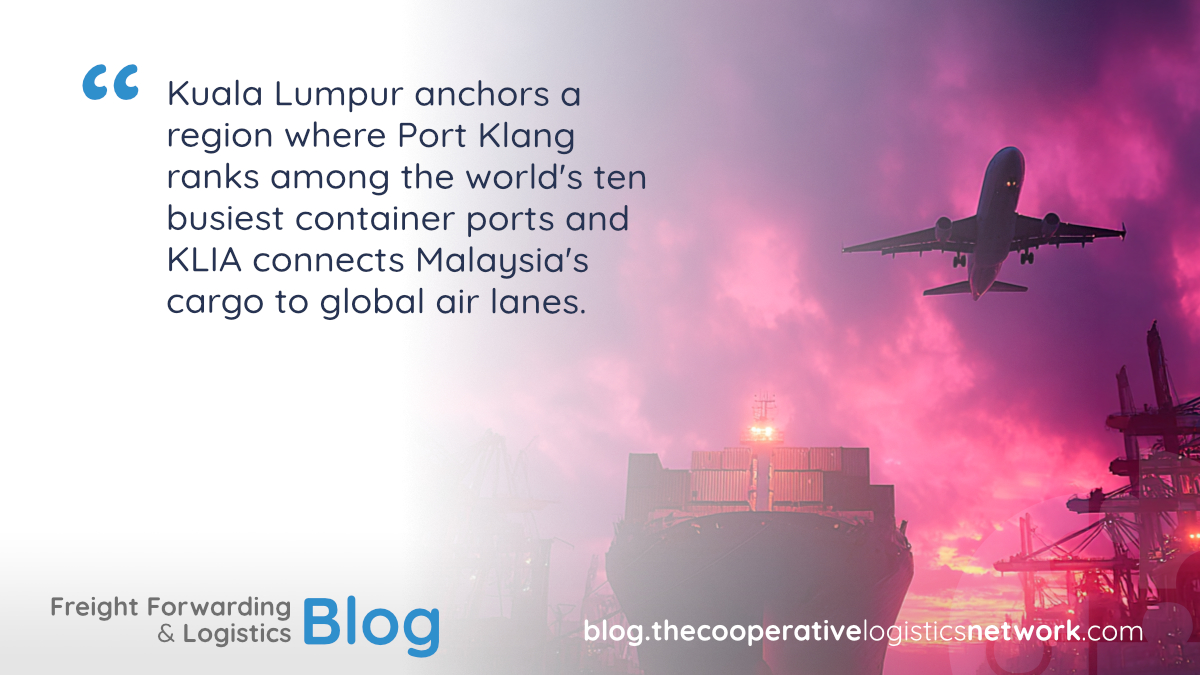
Port Klang Commands a Place Among the World’s Ten Busiest Ports
Port Klang processed a record 15.14 million TEUs in 2025, a 3.4% gain on the 14.64 million of 2024, and now ranks among the ten busiest container ports on the planet. Transshipment volumes grew 6.2% to 8.41 million TEUs, a clear signal that carriers rely on Malaysia to redistribute cargo across the region. Momentum has carried into 2026, with Port Klang running 5% ahead of last year through May. Malaysia’s ports collectively handled about 33.07 million TEUs in 2025, and the Port of Tanjung Pelepas became the first single terminal in the country to clear 14 million.
The World Top Container Ports ranking attributes the growth to all three major cargo streams. New electric vehicle models boosted imports, while glass, automotive parts, gloves, and furniture sustained exports. Analysts single out the planned Westports expansion as the decisive variable for the coming decade, because the terminal already operates at roughly 82% of capacity. Looking further ahead, Malaysia envisions a fully integrated Port Community System that links ports, shipping lines, and the wider logistics industry through a single trusted digital platform.
KLIA Gives Malaysia Its Air Cargo Edge
Overhead, the air cargo platform gathers pace. Malaysian airports handled 272,939 tonnes of cargo in the second quarter of 2025, a 4.4% increase year on year, with international freight accounting for 74.3% of the total. The government has designated Kuala Lumpur International Airport, Penang, Kota Kinabalu, and Senai as cargo aviation hubs, and the Transport Minister highlights KLIA’s air, sea, and land connectivity together with a Free Commercial Zone that supports international trade. Where Port Klang delivers ocean scale, KLIA contributes air speed, and the Kuala Lumpur logistics hub unites both within a single region.
Two Cargo Flows That Define the Opportunity
Consider electric vehicles arriving by sea. New models lifted imports through Port Klang in 2025, and each shipment demands vessel coordination, customs clearance, and inland delivery within Malaysia. A forwarder whose partner manages those steps on the ground protects the manufacturer’s schedule and the dealer’s launch date.
Consider next the e-commerce parcels travelling by air from Zhengzhou. Cargo on that route to Kuala Lumpur grew from 437 tonnes in 2023 to 1,812 tonnes in 2024, then surged to 11,635 tonnes by September 2025, while weekly flights climbed from three to ten. The Transport Minister has pitched KLIA as a transshipment centre for Chinese e-commerce players, which creates a corridor where forwarders with a reliable agent in Kuala Lumpur can route cargo onward and manage customs and delivery across Southeast Asia.
Why Local Partners Define Service Quality
Freight forwarders in Malaysia and their overseas counterparts depend on each other more than any brochure admits. A strong local partner handles customs clearance, documentation, trucking, warehousing, and last-mile delivery, answers queries in your customer’s time zone, and shares market intelligence on rates, schedules, and regulations. That intelligence sharpens your quotations, and consistent delivery turns a single booking into a lasting account. Reciprocity completes the picture: partners who send steady cargo to Malaysia find the relationship rewarding on both sides.
Building Your Business Around the Kuala Lumpur Logistics Hub
Infrastructure opens doors, and relationships carry cargo through them. The Cooperative holds that the strongest business relationships rest on trust, and that trust grows best in person. A single conversation across a table reveals response times, operational depth, and working style, qualities that months of correspondence reveal only slowly. Forwarders who invest in that conversation enter the Kuala Lumpur logistics hub as known quantities rather than strangers.
The Cooperative Annual Meeting in Kuala Lumpur
From 21 to 23 May 2027, The Cooperative Logistics Network convenes its 10th Annual Meeting at the Shangri-La Kuala Lumpur, drawing partners from more than 130 countries under one roof. Delegates book 20-minute one-to-one meetings through an online scheduler ahead of the event, which directs every slot toward a partner who matters to their business. A welcome cocktail reception, shared lunches, coffee breaks, and a gala dinner extend those conversations into a more relaxed setting.
An optional day trip on 21 May carries delegates and spouses through Batu Caves, Thean Hou Temple, the National Mosque, and a photo stop at the Petronas Twin Towers. The itinerary doubles as an introduction, giving new members an easy way to meet colleagues before the business sessions open. Register before 29 January 2027 to secure the early bird discount.
Join The Cooperative Logistics Network
Kuala Lumpur rewards forwarders who arrive with the right partners. The Cooperative Logistics Network connects freight forwarders with trusted counterparts across the globe and gathers them in person every year. Apply for membership, reserve your place at the 10th Annual Meeting, and begin building the partnerships that move cargo through Port Klang, KLIA, and far beyond.