
Ask anyone tracking Western freight corridors where the next major logistics center is forming, and Salt Lake City comes up fast. What used to be a regional distribution point is turning into something bigger: a genuine multimodal hub with the infrastructure, investment, and industrial land to back it up. For freight forwarders, the shift happening in and around this city right now is worth paying close attention to.
The Inland Port Is Maturing, Not Just Growing
The Utah Inland Port Authority has moved past its early build-out phase and into a more mature stage of development. The authority recently committed an additional $2.5 million toward Great Salt Lake shoreline preservation and wetland conservation, bringing its total conservation investment to $7.5 million this year alone. That funding follows years of friction between the state and Salt Lake City over how the port’s profits should be spent, and the two sides have now settled into a coordinated model that channels some of that money into public safety and environmental protection in the surrounding Northwest Quadrant.
This matters for forwarders because it signals durability. An inland port that survives its early political conflicts and settles into a stable funding structure is one that shippers and carriers can plan around for the long term, rather than treating as a temporary experiment.
New Industrial Capacity Is Coming Online
One of the more striking developments is the transformation of a decades-old municipal landfill sitting between the airport and the Great Salt Lake. The Inland Port Authority purchased the roughly 770-acre site and is now several years into a remediation project expected to cost upward of $200 million, to turn it into a hub for advanced manufacturing. Projects like this represent real future freight volume, not speculative growth. When a corridor is actively converting dead industrial land into productive capacity, forwarders who build relationships early are the ones positioned to move that first wave of freight.
At the same time, the region is drawing significant data center investment near the Great Salt Lake, with state incentives pulling in hyperscale computing campuses. Data center construction generates its own freight demand: oversized transformers, generators, and specialized equipment that require project cargo expertise rather than standard truckload or LTL handling. That is a growth niche that rewards forwarders who can coordinate heavy-haul permitting and specialized carriers well in advance of a build.
Two Shipments That Illustrate the Shift
Picture a manufacturer relocating a light-industrial production line into the newly redeveloped former landfill site once remediation clears a phase for occupancy. That move involves coordinating specialized machinery transport, sequencing multiple inbound shipments to match a construction and occupancy timeline, and managing import logistics if any of the equipment originates overseas. A forwarder unfamiliar with the site’s phased redevelopment could easily misjudge access windows or road weight restrictions still in effect around the Northwest Quadrant.
Now picture a data center developer near the lake importing specialized cooling and power infrastructure from Germany and South Korea. That shipment demands air and ocean coordination, careful HS classification for high-value electrical equipment, and a domestic drayage plan built around heavy-haul routing to a site that may not yet have finished road access. Both shipments reflect the same reality: Salt Lake City’s growth is creating freight that is more complex and more specialized than the general cargo the market handled a decade ago.
Rising Costs Are Part of the Story Too
None of this growth is coming cheap. A recent federal warehouse purchase within the inland port’s project area closed at $145 million, well above assessed value, and local officials have openly acknowledged that pricing pressure in the Northwest Quadrant is a real concern for keeping the corridor affordable to smaller operators. That is exactly the kind of market condition where an independent forwarder’s margins get squeezed the most: rising real estate and warehousing costs on one side, and larger, better-capitalized competitors moving into the same corridor on the other.
Why Salt Lake City’s Logistics Strength Depends on Global Partnerships
Salt Lake City has quietly become one of the most important inland logistics hubs in the western United States. Sitting at the crossroads of major interstate highways, a major rail switching network, and a growing air cargo operation, the city allows businesses to move freight efficiently between the West Coast, the Mountain States, the Midwest, and international markets. Moving cargo beyond North America, however, takes more than an advantageous location. It takes trusted logistics partners who can coordinate shipments across multiple countries while maintaining visibility, compliance, and consistent service from origin to destination.
This is where a network like The Cooperative Logistics Network creates measurable value. The network connects members with carefully vetted partners across major logistics gateways worldwide, giving Salt Lake City forwarders the tools to strengthen origin and destination coordination, sharpen communication throughout the shipment lifecycle, and deliver consistent service across an increasingly complex global trade landscape. As Salt Lake City continues to grow into a genuine Mountain West gateway, access to experienced overseas partners becomes a competitive necessity rather than a convenience.
A Trusted Global Network
The Cooperative brings together carefully selected independent freight forwarders across more than 137 countries, giving members access to a dependable network of logistics specialists in key international markets. Instead of relying on unfamiliar agents picked up on short notice, members work with trusted partners committed to long-term relationships, operational excellence, and consistent service standards. For a Salt Lake City forwarder booking freight into markets they rarely touch directly, that established relationship is often the difference between a shipment that clears smoothly and one that stalls at a border.
Stronger Coordination Across Inland Supply Chains
Cargo moving through Salt Lake City frequently combines rail, air, and long-haul trucking before reaching its final destination, whether that freight is heading toward the West Coast ports or out to international buyers. Consider a Utah medical device manufacturer exporting diagnostic equipment to distributors in Japan. That shipment needs precise customs documentation on the export side, tight coordination with an air cargo partner, and a destination agent in Japan who understands the regulatory requirements for medical equipment imports.
Now consider an outdoor recreation brand shipping finished apparel and gear to retail partners across Europe, where consolidated ocean freight routed through West Coast ports needs a European partner ready to manage last-mile distribution across several countries. Both shipments depend on the same thing: efficient communication between an origin forwarder in Salt Lake City and a destination partner who can be trusted to execute without constant oversight. Working within a coordinated network minimizes the operational delays that come from working through unfamiliar agents and lets forwarders deliver consistently reliable service.
Supporting Diverse Industries and Trade Lanes
Salt Lake City serves a wide range of industries, including outdoor recreation, medical devices, aerospace components, technology hardware, and advanced manufacturing. These sectors demand logistics providers capable of handling time-sensitive shipments, specialized cargo, and complex cross-border movements without losing visibility along the way. Access to experienced overseas partners allows Salt Lake City forwarders to confidently take on specialized shipments in these industries rather than turning business away because the destination market feels unfamiliar.
Building Relationships That Drive Growth
The Cooperative’s Annual Meetings strengthen these partnerships through structured one-to-one meetings and face-to-face networking opportunities. In an industry where trust, responsiveness, and local expertise are critical, these personal connections create lasting business relationships and generate new opportunities for collaboration across international markets. A forwarder who has sat across the table from their destination partner in Rotterdam or Singapore operates with a different level of confidence than one working through an email introduction alone.
Helping Salt Lake City Forwarders Compete Globally
As Salt Lake City continues to strengthen its role as an inland Mountain West gateway, membership in The Cooperative Logistics Network equips freight forwarders with the global partnerships, local expertise, and collaborative support needed to deliver efficient supply chain solutions and compete successfully in an increasingly integrated global market.
Looking Beyond Traditional Coastal Gateways
While America’s major seaports remain essential to global trade, an increasing share of cargo is being routed through inland hubs that offer greater flexibility and access to regional markets. Salt Lake City has emerged as one of these strategic gateways, connecting Mountain West manufacturers and exporters with international markets through its rail, highway, and air cargo infrastructure, without ever needing a coastline of its own.
For freight forwarders, understanding Salt Lake City’s evolving role provides a valuable competitive advantage. By combining strong local expertise with reliable international partnerships, they can offer customers more efficient routing options, greater supply chain resilience, and seamless cross-border logistics solutions. As American trade continues to evolve, Salt Lake City is proving that the country’s most important logistics hubs are defined not only by infrastructure, but by their ability to connect markets, industries, and global supply chains.
The Window to Establish a Foothold Is Now
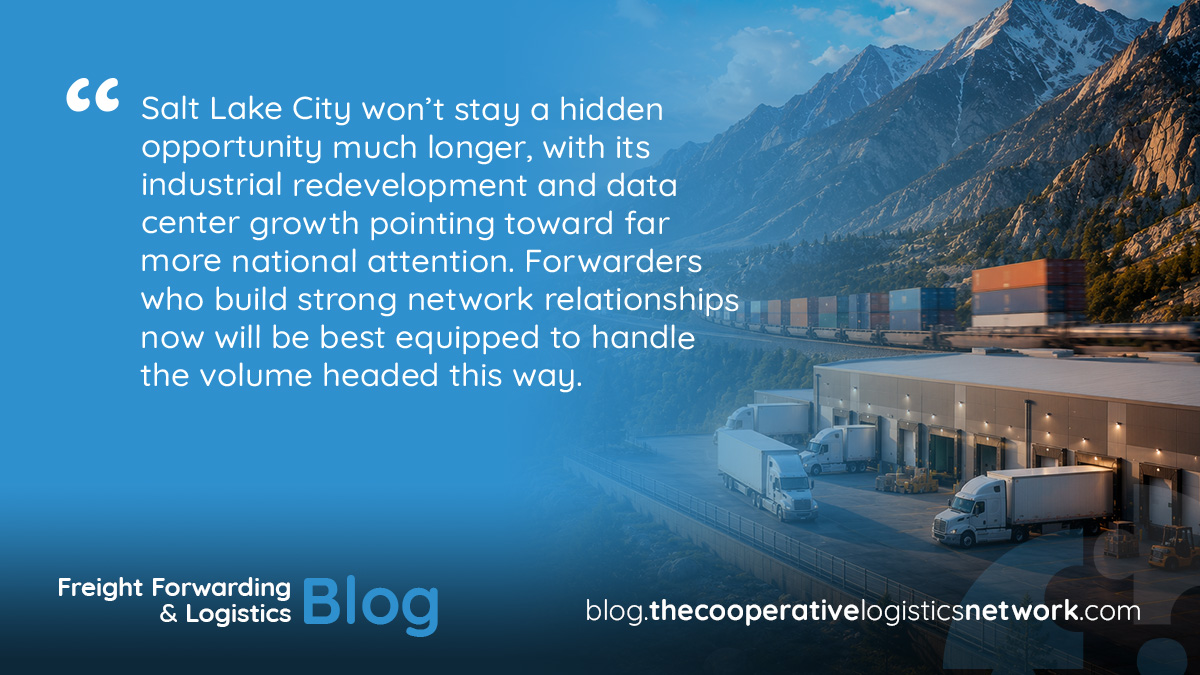
Salt Lake City is not going to stay a hidden opportunity much longer. The inland port’s stabilizing governance, the redevelopment of major industrial sites, and the arrival of data center investment all point toward a market that is about to attract far more attention from national and global players. Forwarders who build strong network relationships in this corridor today will be the ones best equipped to handle the freight volume and complexity headed this way.
If you are a freight forwarder working in or around Salt Lake City and want to talk through what membership in The Cooperative Logistics Network could mean for your business, reach out today. The Mountain West’s next major logistics hub is forming right now, and there is real advantage in being part of the right network before everyone else catches on.