

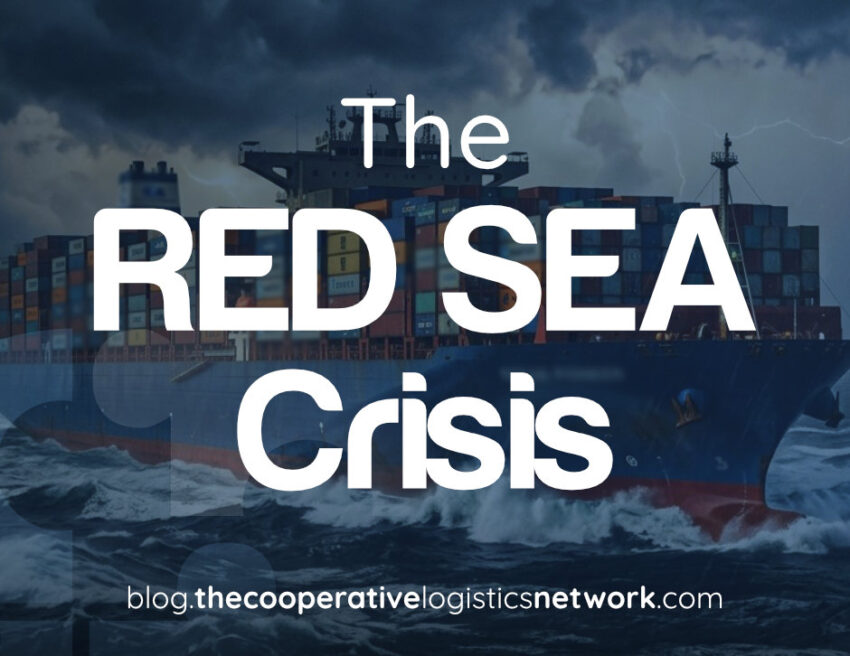
In late 2023, the news came in fast. Houthi rebels in Yemen were targeting commercial vessels in the Red Sea. Carriers were rerouting. Rates were climbing. The industry held its breath and waited for it to blow over. Two and a half years later, the Red Sea shipping disruption 2026 is no longer a crisis in the acute sense but it hasn’t ended either. It has become something more unsettling: a permanent feature of the global freight landscape that the industry has had to learn to live with, plan around, and ultimately absorb into how it operates.
For freight forwarders, the last two years have been one of the most instructive and at times punishing periods of professional development imaginable. The disruption exposed weaknesses, rewarded adaptability, and permanently changed what it means to run a resilient forwarding business. Here’s what the industry has actually learned.
What the Red Sea Shipping Disruption 2026 Still Looks Like on the Ground
Before the lessons, a clear-eyed look at where things stand. The Suez Canal, which in normal times carries around 30% of Asia-Europe container traffic, has seen a dramatic fall in volumes since the crisis began. By early 2025, container traffic through the canal had plummeted 90% compared to March 2023. Most major carriers Maersk, MSC, Hapag-Lloyd, CMA CGM rerouted their services around Africa’s Cape of Good Hope, adding 10–14 days to voyages and boosting fuel consumption significantly.
There was a brief window of cautious optimism in early 2026. Houthi attacks reduced in frequency, some carriers began tentatively testing Suez transits again, and freight rates started to ease. Then, US-Israel airstrikes on Iran and Tehran’s retaliatory response across the Middle East effectively ended that experiment. Any plans for a phased return of container shipping to the Red Sea in 2026 were shelved until the security situation becomes clearer. As of mid-2026, industry consensus is that Cape of Good Hope diversions will continue through at least 2027. The Red Sea isn’t closed, it’s just not reliably open. And for freight planning purposes, that amounts to much the same thing.
Lesson One: The “New Normal” Is Not a Cliché: It’s an Operational Instruction
The industry’s first instinct when the crisis began was to treat it as a temporary disruption requiring a temporary fix. Add buffer days. Adjust schedules. Wait it out. What became clear over the following months was that it was a cost centre. The forwarders who adapted fastest were the ones who stopped thinking about Cape of Good Hope routing as a detour and started treating it as the default. That mental shift sounds simple. In practice, it means rebuilding transit time estimates from scratch, renegotiating service contracts with Cape routing built in, repositioning inventory assumptions, and resetting client expectations all at once, while volumes keep moving.
The logistics and freight market now favors routes that provide stable planning cycles, even at the expense of longer transit times. Reliability, it turned out, is worth more than speed when speed can’t be guaranteed. That lesson has outlasted the peak of the crisis and shaped how smart forwarders now think about route selection across the board.
Lesson Two: Your Carrier Relationships Are Your Crisis Infrastructure
When the Red Sea disruption hit, the forwarders who fared best were the ones with the deepest carrier relationships. Space on Cape-routed services became scarce fast. Carriers were managing redeployment across their entire fleets, adding tonnage on longer routes, and prioritising their most reliable commercial partners. Forwarders with strong, long-term carrier relationships found themselves able to secure space. Those who had operated primarily on spot markets, chasing the best rate each time, found themselves at the back of a very long queue.
This is the part of the resilience conversation that often gets skipped in favour of technology talk. Digital visibility tools matter. TMS platforms matter. But when a major shipping lane closes and every forwarder in the market is scrambling for the same capacity, none of that replaces a phone call to someone who knows you and trusts you.
Lesson Three: Clients Need a Translator, Not Just a Forwarder
The Red Sea shipping disruption 2026 also changed the nature of the conversation between freight forwarders and their clients and the forwarders who handled that conversation well earned something that rates and transit times can’t buy: trust.
Shippers, especially those without deep logistics expertise in-house were confused, anxious, and sometimes getting conflicting information from multiple sources. The forwarders who stepped into that vacuum as genuine advisors, explaining what was happening, why it was happening, what the options were, and what each option would cost in time and money, built relationships that have proved durable. Those who went silent, or simply passed on carrier surcharges without explanation, saw clients start looking elsewhere. In a disruption of this scale, communication is as much a service as the freight itself.
Lesson Four: Insurance and Risk Weren’t Optional, They Were the Whole Point
War risk insurance premiums for Red Sea routing became, almost overnight, a significant line item. Forwarders who had treated cargo insurance as an afterthought found themselves in difficult conversations with clients whose cargo was affected by attacks, delays, or the consequential costs of rerouting. The crisis was a hard reminder that the freight forwarding value proposition includes risk management and that forwarders who can advise intelligently on insurance, liability exposure, and the implications of different routing choices are providing something categorically different from a platform that just compares rates. For the forwarders who had built that expertise, the crisis was actually a moment of demonstration. For those who hadn’t, it was an expensive education.
Lesson Five: Resilience Requires a Network, Not Just a Plan
Perhaps the deepest lesson of the past two years is one that applies to the industry’s structure as much as its operations. Independent freight forwarders operating in isolation without trusted partners in the right ports, without agents who know alternative routing options, without the kind of real-time intelligence that flows through an active logistics network, are structurally exposed in a way that no internal planning document can fix.
The Red Sea disruption rewarded forwarders with reach. When the standard lane closed and cargo needed to move via alternative ports, different transshipment hubs, and non-standard services, the forwarders who had reliable partners already in place across those routes were the ones who could deliver. The ones who had to find new agents in the middle of a crisis while managing anxious clients and scarce capacity — found out what resilience actually costs to build under pressure. Supply chain diversification, multi-route strategies, and strong regional networks are now being treated as operational infrastructure rather than aspirational goals.
Where Things Stand and What Comes Next
The Red Sea isn’t going to resolve on a timeline that freight forwarders can plan around. The geopolitics are too layered, the regional tensions too entrenched. What the industry can do , what the best operators are already doing, is build businesses that don’t depend on any single lane, any single carrier, or any single assumption about how the world should work.
The freight forwarding businesses that have come out of this period stronger are the ones that leaned into the complexity. They diversified their routing knowledge, deepened their carrier partnerships, invested in client communication, and built or joined networks like the Cooperative, which gave them genuine reach when reach was what their clients needed most.
The Red Sea shipping disruption 2026 has been two years of hard lessons. But hard lessons, absorbed properly, are the foundation of a more resilient industry. And resilience, as it turns out, is exactly what clients are now prepared to pay for.