


Air cargo has always revolved around major gateways. Think of the busiest international airports and you’ll find vast cargo terminals, dense flight schedules, and constant movement. But something is changing beneath the surface. A growing share of freight is no longer flowing exclusively through these mega hubs. Instead, it’s being rerouted, redistributed, and reimagined through secondary airports air cargo logistics. This shift is a response to pressure, inefficiencies, and the need for smarter, more flexible systems. What this really means is that smaller and regional airports are stepping into roles that were once dominated by the biggest names in aviation logistics.
Why Air Cargo Is Shifting to Secondary Airports
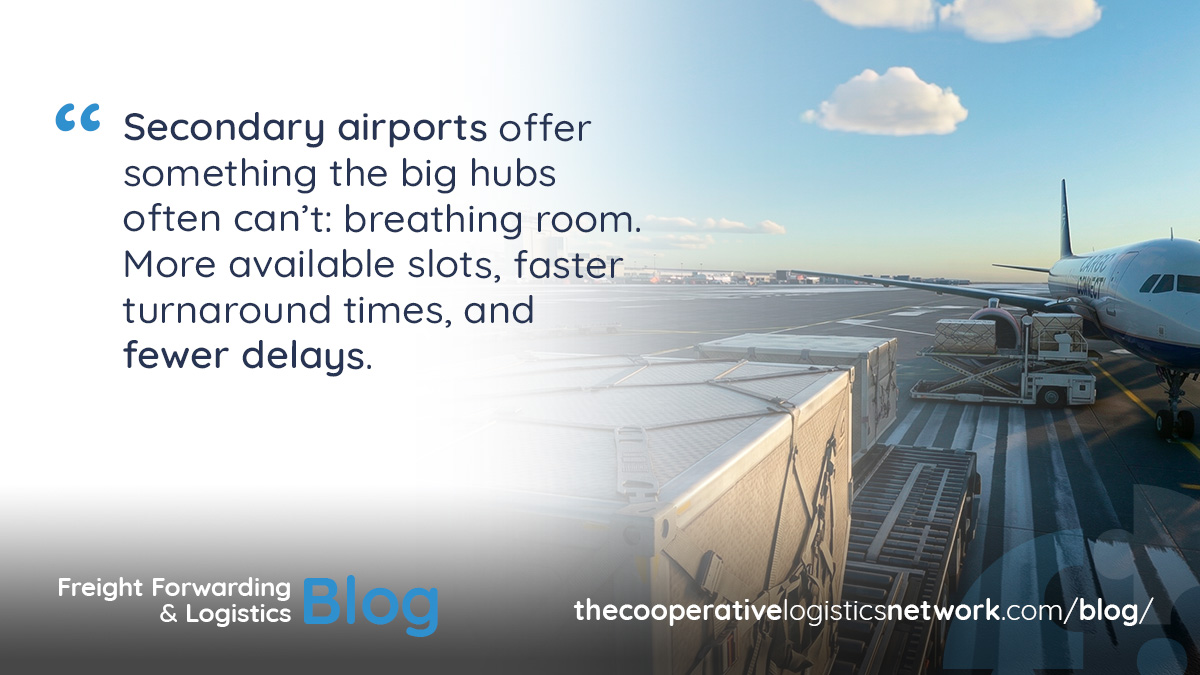
For years, the logic was simple: concentrate operations at major hubs for maximum connectivity. But as global trade volumes surged, that model started showing cracks. Airport congestion and other air cargo challenges have become a daily reality at leading gateways, where limited slots, long ground times, and operational bottlenecks slow everything down. That’s where secondary airports air cargo operations come into play. These airports offer something the big hubs often can’t: breathing room. More available slots, faster turnaround times, and fewer delays.
The shift is also being driven by evolving air freight routing strategies. Logistics planners are no longer thinking in straight lines between major cities. Instead, they’re building networks that prioritize efficiency over tradition. Routing cargo through less congested airports can reduce transit times and improve reliability, even if the route looks less direct on paper.
The Rise of Alternative Air Cargo Hubs
What used to be considered backup locations are now emerging as alternative air cargo hubs. These airports may not have the scale of traditional global air cargo hubs, but they offer something equally valuable: flexibility. In many cases, secondary air cargo hubs are strategically located near industrial zones, manufacturing clusters, or key consumption markets. That proximity reduces the need for long inland transportation, which can significantly cut costs and transit times.
At the same time, governments and airport authorities are investing heavily in air freight infrastructure at these locations. Modern cargo terminals, improved handling systems, and better road connectivity are turning regional cargo airports into viable alternatives for high-volume operations. This is how alternative air cargo gateways are redefining the map of global logistics. Instead of relying on a handful of overloaded mega hubs, the system is becoming more distributed and resilient.
How Secondary Airports Support Global Air Cargo Networks
The role of regional airports air cargo logistics goes beyond simply easing congestion. These airports are becoming integral nodes in a much larger network. To understand how secondary airports support global air cargo networks, you have to look at the bigger picture. Cargo doesn’t just move from origin to destination. It flows through interconnected systems that depend on timing, coordination, and capacity.
Secondary airports help balance that system. They absorb overflow from major hubs, provide alternative routing options during disruptions, and enable more direct connections between smaller markets. This distributed approach strengthens the overall network. If one hub faces delays or operational issues, cargo can be rerouted through another without bringing the entire chain to a halt. That kind of resilience is becoming increasingly important in a world where disruptions, from weather to geopolitical events, are more frequent.
Solving Congestion with Smarter Routing
One of the most practical advantages of this shift lies in air cargo congestion solutions using regional airports. Instead of waiting for capacity to open up at a major hub, freight can be redirected through less crowded facilities. This approach is closely tied to advanced air cargo capacity management. Logistics providers are using data and forecasting tools to decide where cargo should flow at any given time. It’s no longer about fixed routes. It’s about dynamic decision-making. By incorporating alternative airports for air freight operations, companies can optimize load distribution, reduce dwell times, and improve overall efficiency. The result is a system that adapts in real time rather than relying on rigid structures.
The Benefits of Secondary Airports for Air Freight Logistics
The benefits of secondary airports for air freight logistics extend across multiple dimensions. First, there’s speed. With fewer aircraft movements and less congestion, cargo can be processed and moved more quickly. Ground handling becomes more efficient, and delays are minimized. Then there’s cost. Lower landing fees, reduced handling charges, and shorter inland transport distances can make a significant difference, especially for high-volume operations. There’s also scalability. As demand fluctuates, secondary airports air cargo logistics allows companies to expand or adjust operations without being constrained by slot limitations at major hubs. Finally, there’s reliability. In logistics, predictability is everything. Secondary airports often provide more consistent performance, which is critical for time-sensitive shipments.
Challenges That Come with the Shift
Of course, the transition isn’t without its challenges. Not all regional cargo airports are fully equipped to handle large-scale operations. While investments in air freight infrastructure are growing, there are still gaps in capacity, technology, and connectivity at some locations. Another issue is network integration. Aligning schedules, ensuring seamless transfers, and maintaining visibility across multiple nodes can be complex. This is where strong coordination and digital tools become essential. There’s also the perception factor. Some shippers still associate major hubs with reliability and may hesitate to move operations to secondary air cargo hubs. Changing that mindset takes time and proven performance.
What This Means for the Future of Air Cargo
The shift toward secondary airports air cargo logistics isn’t a temporary workaround. It’s a structural change in how the industry operates. As global trade continues to evolve, the demand for flexible, resilient, and efficient logistics solutions will only grow. Air cargo secondary hubs will play a key role in meeting that demand, complementing rather than replacing traditional hubs. We’re moving toward a hybrid model where global air cargo hubs handle high-volume intercontinental flows, while alternative air cargo gateways and regional airports manage distribution, overflow, and specialized routes. This layered approach makes the entire system stronger. It reduces dependency on a few critical points and creates a network that can adapt to changing conditions.
A More Distributed, More Efficient Network
At its core, this shift is about rethinking how cargo moves through the world. Instead of concentrating everything in a handful of locations, the industry is embracing a more distributed model. One that uses regional airports air cargo logistics to unlock new efficiencies and reduce pressure on overstretched hubs. For logistics providers, this means revisiting air freight routing strategies and investing in partnerships with emerging hubs. For shippers, it opens up new possibilities for faster, more reliable deliveries. And for the industry as a whole, it signals a move toward a smarter, more balanced system. Secondary airports air cargo logistics may not always be in the spotlight, but it’s quietly reshaping the future of global freight, one route at a time.