

Few places matter to global trade the way Singapore does. On any given day, thousands of containers pass through its terminals, linking factories, markets, and consumers across continents. The Port of Singapore is precise, disciplined, and relentlessly efficient. In an era where port congestion has become almost normal elsewhere, Singapore continues to move cargo with remarkable consistency. For freight forwarders, carriers, and shippers, understanding how this port works is more than academic. It explains why Singapore remains the backbone of Asia-Europe, transpacific, and intra-Asia trade, and why it continues to outperform other global transshipment ports.
Why the Port of Singapore matters to global trade
Geography gave Singapore an advantage. Strategy turned it into a powerhouse. Sitting at the crossroads of major east-west shipping lanes, Singapore evolved early into a Singapore transshipment hub. Today, more than 80 percent of its containers are transshipped, connecting over 600 ports worldwide. This makes it one of the most critical global transshipment ports in the world. What sets Singapore apart is not just volume. It is how smoothly that volume is handled. Even as ships grow larger and supply chains become more volatile, container throughput Singapore continues to scale without the chronic delays seen elsewhere.
The Cooperative Logistics Network advantage in Singapore
Access matters as much as infrastructure. Through The Cooperative Logistics Network, members benefit from collaboration with three trusted and vetted agents in Singapore, each deeply experienced in handling cargo through the Port of Singapore. By working with them, members gain reliable on-the-ground execution in one of the world’s most demanding port environments. Beyond Singapore, The Cooperative connects forwarders to more than 365 trusted agents across 139 countries, enabling seamless coordination across global trade lanes. In a hub as critical as Singapore, trusted local collaboration is a competitive edge.
Port of Singapore operations: precision at scale
At the heart of this success are highly disciplined Port of Singapore operations. Everything, from berth allocation to yard planning, is optimized to reduce idle time.
Key operational strengths include:
-
Fast vessel turnaround times
-
High crane productivity
-
Predictable cut-off and gate schedules
-
Seamless coordination between terminals and shipping lines
This level of operational efficiency at the Port of Singapore is not accidental. It is the result of decades of investment, process refinement, and tight public-private coordination. For carriers, this reliability reduces schedule risk. For forwarders, it means fewer surprises and more control over transit times.
PSA Singapore operations and the human-machine balance
Much of Singapore’s port activity is driven by PSA Singapore operations, the terminal operator that has become a benchmark for port performance globally. PSA’s approach blends automation with human oversight. Automated quay cranes, yard cranes, and guided vehicles handle repetitive tasks, while experienced planners manage exceptions and peak pressures. This balance explains how PSA Singapore uses automation without losing flexibility. Rather than replacing people, automation supports faster decision-making. This is especially critical during disruptions, when rigid systems elsewhere tend to fail.
How Singapore avoids port congestion
In recent years, many major ports have struggled with congestion. Singapore has not been immune, but it has managed far better than most. The question many ask is how Singapore avoids port congestion even at extreme volumes. The answer lies in planning and data. Advanced container flow management Singapore port systems monitor yard density, vessel schedules, and hinterland movements in real time. When pressure builds, operations are adjusted before bottlenecks form. Berth windows are tightly controlled, and coordination with carriers is constant. This proactive approach significantly reduces port congestion Singapore, even during global shipping surges.
Smart port technology and digitization
Technology is deeply embedded in maritime logistics Singapore. The port’s digital ecosystem connects terminals, shipping lines, forwarders, customs, and hauliers through shared platforms. Key elements of smart port technology Singapore include:
-
Predictive analytics for vessel arrivals
-
AI-driven yard optimization
-
Digital twin models for terminal planning
-
Integrated port community systems
This focus on port digitization in Singapore logistics improves visibility across the supply chain. For forwarders, better data means better customer communication and tighter planning.
Tuas Mega Port and the future operating model
The next phase of Singapore’s port evolution is already underway. The Tuas Mega Port operational model represents one of the most ambitious port projects globally. Once fully completed, Tuas will consolidate existing terminals into a single, highly automated facility with capacity exceeding 60 million TEUs annually. Designed from scratch, it prioritizes:
-
Full automation
-
Energy efficiency
-
Scalable terminal layouts
-
Advanced cybersecurity
For global shipping, Tuas strengthens Singapore’s role as the dominant Southeast Asia shipping hub for decades to come.
Singapore port impact on global shipping routes
Because so much cargo is transshipped here, the Singapore port impact on global shipping routes is enormous. Changes in Singapore ripple outward. When Singapore runs smoothly, network reliability improves across Asia-Europe, Asia-Middle East, and Asia-Africa lanes. When disruptions occur, carriers must rethink entire rotation strategies. This centrality explains why Singapore remains the preferred node in the transshipment strategy Southeast Asia, even as neighboring ports invest heavily in capacity.
Are there alternatives to Singapore port for transshipment?
Other ports are trying. Tanjung Pelepas, Port Klang, Laem Chabang, and even Colombo are often discussed as alternatives to Singapore port for transshipment. Each has strengths. None yet matches Singapore’s combination of connectivity, reliability, neutrality, and scale. Most alternatives rely heavily on specific carrier alliances or regional flows. Singapore serves everyone. For forwarders, this means Singapore remains the safest consolidation and redistribution point, especially for complex, multi-origin cargo.
What this means for freight forwarders
For freight forwarders, the Port of Singapore logistics ecosystem offers both opportunity and responsibility.
Opportunity, because:
-
High-frequency sailings support flexible routing
-
Reliable transshipment reduces buffer inventory
-
Digital systems improve visibility and planning
Responsibility, because:
-
Precision is expected
-
Documentation errors are less tolerated
-
Local expertise matters
This is where strong partnerships become critical
Why the Port of Singapore keeps winning
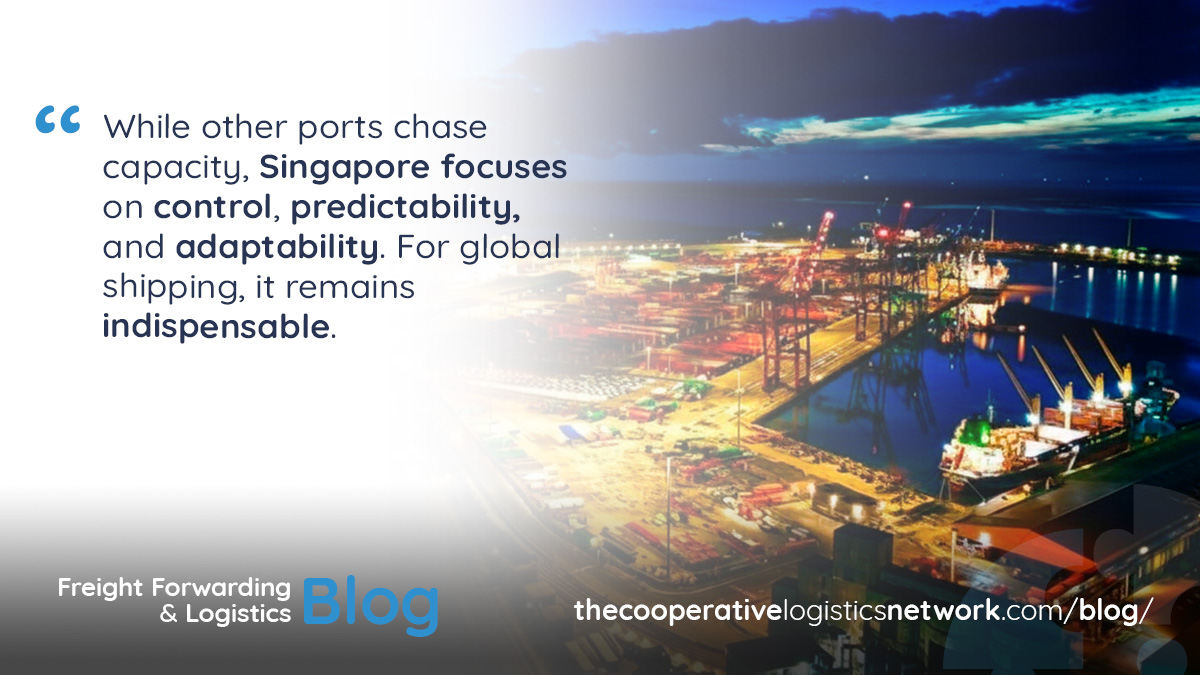
The Port of Singapore succeeds because it treats efficiency as a system. Operations, technology, policy, and partnerships all reinforce each other. While other ports chase capacity, Singapore focuses on control, predictability, and adaptability. For global shipping, it remains indispensable. For forwarders, it is a reminder that in logistics, excellence is built daily, container by container. And as global supply chains grow more complex, Singapore’s role as the world’s most dependable transshipment hub looks set to endure.